


Bundle up because this has the potential to be a particularly cold December for Nebraska football. This is the knock-on effect of a 7-5 season that didn’t demonstrate obvious progress outside of 7 regular-season wins being more than 6 which was more than 5. I’m pushing that debate to the side because if there’s a debate at all it means it wasn’t clear, much less what anyone hoped in the optimism-only offseason.
I think the next 6 weeks or so have the potential to be a period of upheaval. That’s not based on rumors or off-the-record conversations, just reason. Nebraska appears stalled in its ascent, and stalled was tough in the old era of college football, but it might be particularly tough now when legal money has been introduced.
Yes, spending more than the next guy still helps you—and Matt Rhule said NU is better equipped for that battle this offseason—but let’s say Nebraska and Indiana are tied for the top offer for the edge rusher both want and need in the portal this January. Does the tie-breaker become the Hoosiers making two straight playoffs versus the Huskers celebrating back-to-back bowl games for the first time since 2015-16?
Logic still dictates that it might matter, and winning still matters for all but the most mercenary. Nebraska has tried to build a program under Rhule that isn’t solely based on the best offer, and that’s wise while also being honorable. It might also be essential at a program like NU’s.
But losing the last two games by a combined score of 77-26, while being a combined underdog of 12 points, could and should shake things up for everyone involved—coaches, players, fans.
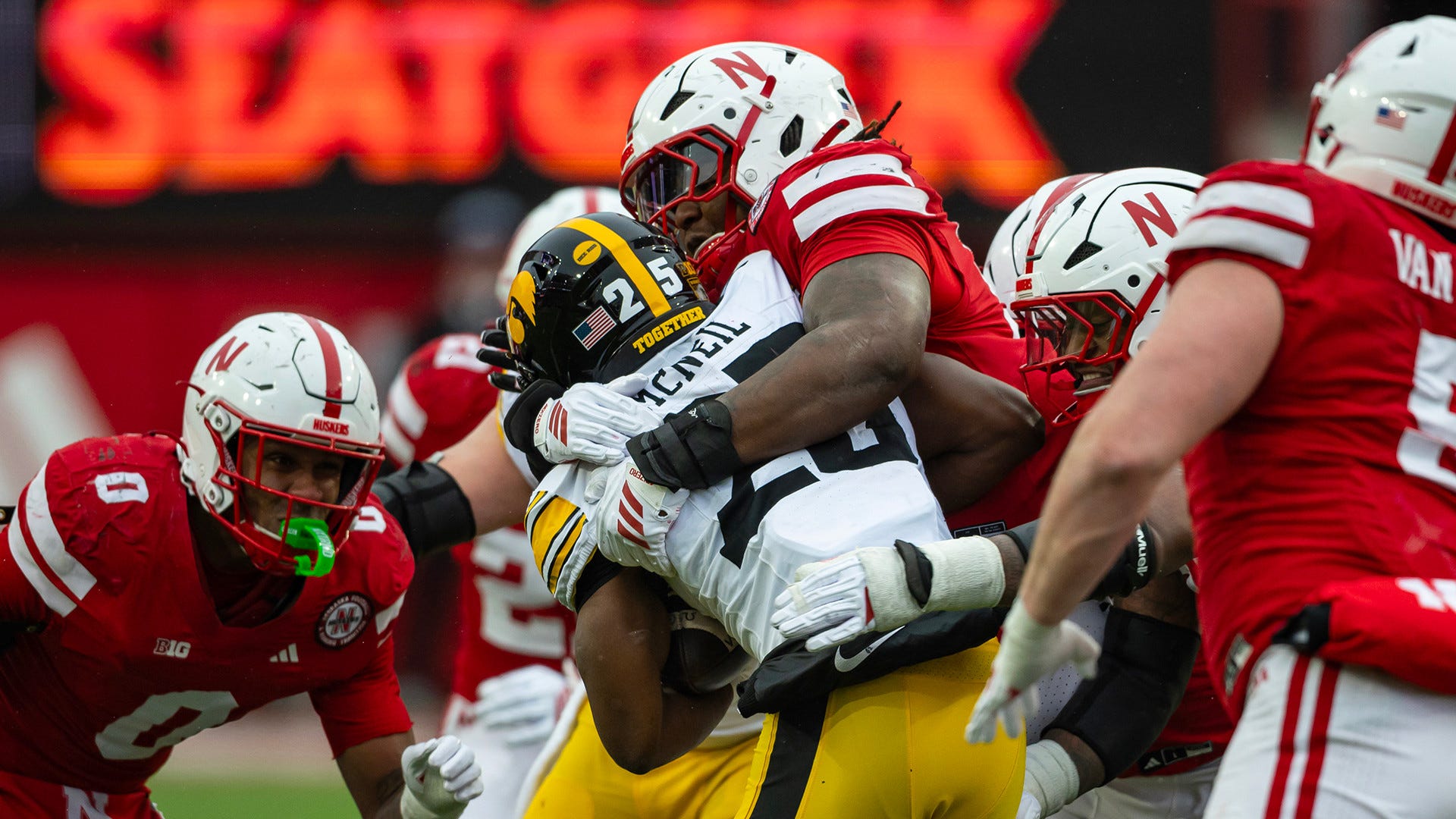
“When you end the season the way we have the last two games, that rests solely on me,” Rhule said after the 40-16 loss to Iowa. That’s wise while also being honorable (and somewhat inevitable1), too.
It’s going to make for a rough couple of weeks, however, as Rhule takes some serious arrows. And if that’s the worst of it come the end of December, that would be a pretty good result.
The conversation around NU’s place and trajectory will continue all offseason. In the hopes of contributing to an informed discussion, let’s just look at some facts.
NU is 2-10 in November
On the day Rhule was introduced in Lincoln, he laid out a vision for fairly traditional, straight-ahead football. Huddle, run the ball, play great defense, be physical—the sort of stuff everyone knows works in the Big Ten. It’s the sort of stuff that’s particularly valuable in November, when injuries and the elements are more frequent wild cards. Rhule talks about the wind in Memorial Stadium all the time. NU put in new outdoor practice fields so the Huskers could be in the elements more often, and Rhule has shared his dream of a warm-weather team coming to Lincoln for a playoff game more than once.
You can’t argue he isn’t aware a Big Ten team needs to be built to thrive in (or at least survive) November. You also can’t argue Nebraska is right now and that’s not just a matter of the schedule itself the past three years. The Huskers’ have slumped in the final act relative to the most objective view of expectation we have.
A team playing at expectation for all three acts of the college football regular season would see its average margin of victory move with the average point spread. Schedule difficulty is accounted for by the line, which is real-time and reflective of whatever context is available up to kickoff. That’s not how it’s worked at Nebraska over three full seasons.
If that chart isn’t the easiest to interpret, take this away from it: In August and September since 2023, NU has won by an average of 12 points while be expected to win by 11.2 for a surplus of 0.8 points or +7%. In October it has been about 57% below expectation and in November it’s -74%.
Nebraska has won one more regular-season game each of the past three seasons, but it’s hard to get ahead when this is the pattern. There’s a November fade to fix—which is big enough on its own—but it’s also clear the Huskers have been fine in nonconference play but basically failed to reach their ceiling in conference. Since 2023, Nebraska is 3.3 points per game below expectation in Big Ten games. The only conference teams below that: Michigan State (-4.9), Maryland (-5.1) and Purdue (-5.3).
There was a mostly satisfying version of the 2025 season where Nebraska went 9-3 without beating any of the traditional heavyweights (Michigan, USC, Penn State) on the schedule. It did lose all those games and added humbling losses to Minnesota and Iowa, programs that should be measuring-stick games.2
“There was nothing that led me to think it would be like this,” Rhule said after the 24-6 loss at Minnesota.
“I didn’t think it would go that way,” he said following Friday’s loss to Iowa.
Knowing what you’re going to get is the ultimate (and perhaps only) marker of quality in coaching. All the evidence indicates the Huskers don’t have it yet.
NU had a lead in 10 games this season
The last time I took an in-depth look at sequencing in college football I found that the team that scored first won just over 67% of the time in the three seasons leading up to 2019. That was the only variable—did you score first?—and it made no attempt to account for team quality.
Nebraska had that edge in seven games this season and, to extend things a bit, the Huskers had a lead seven times after two drives (one for each team). In three more games, Nebraska led at some point.3 These edges often don’t feel that big in the context of an individual game, but there’s no doubt any lead is an advantage lost. The Huskers may have finally finished above .500 in one-score games this year (4-2), but unlocking something more likely meant extending the advantages they’d already earned.
And it’s because Nebraska wasn’t so snake-bitten in close games4 that its inability to extend earned leads for anything better than 7-5 points toward the sidelines.
For three quarters this season, Nebraska scored (and didn’t allow scores) like a nine-win team. In the first, second and fourth quarters this year the Huskers outscored opponents 281-179. By Pythagorean expectation, that differential projects 8.9 wins over 12 games. Add in the third quarter, where NU was outscored, 97-70, and that same projection drops to 7.5 over 12 games, basically where the Huskers landed.
We’ve discussed Nebraska’s multi-year lack of success out of halftime5 here before, but 2025 was also dotted with curiosities outside of the 15-minute break. There were leads turned down (Michigan), timeouts lost to indecision and the short-yardage Heinrich Haarberg6 package that seemed to complicate things more for NU than it did the opponent.
If the name of the game is reducing randomness—which a lead can do, but so can better adjustments and decision-making—Nebraska didn’t put a bunch of good tape out there.
Iowa and Penn State only threw 28 times combined
Two things were obvious pretty early on for Nebraska in 2025—it struggled to protect the passer and struggled to stop the run. The latter was easier to understand7 than the former,8 but by midseason it was clear both were facts.
Nebraska’s response to those facts was…interesting.
Defensively, we all could look at the November slate and think “get ready for a bushel of runs.” All of the remaining opponents could and wanted to run it, but against USC and UCLA it looked like Nebraska was making it work. Both opponents were able to run the ball, but Nebraska kept the dam from breaking on a really big gain and both had to throw into that legitimately good pass defense 20-plus times.
I don’t know if it was part of the pregame plan or part of in-game adjustments, but NU dialed up its run blitzes against Penn State and Iowa and it didn’t successfully stop the run well enough for a win while leading to two of the best passing games9 against the Huskers of the year. The Nittany Lions and Hawkeyes were able to gain yards through the air on minimal attempts. The three losses this season by more than one score, so that lumps in Minnesota, all came with 20 or fewer pass attempts.10
That’s telling of how legit the pass defense was this season and also telling of how far it could take Nebraska on its own.
Offensively, Nebraska’s reaction to the reality of pass-protection failures was basically stop dropping back, which was true before Dylan Raiola was injured against USC. With him out, things really became “maybe Emmett can win it.” Johnson basically did against UCLA and did almost all he possibly could11 against Penn State and Iowa.
This all sounds like triage more than treatment—and that’s often what winning in November requires—but it wasn’t good enough triage.
All of the facts included above point to a program existing in a middle ground, and it’s a dangerous place to be exiting Year 3. That’s true anywhere, but it might be especially true here given Rhule’s previous track record for his teams taking a jump in this season.
He’s a good coach. He’s made Nebraska slightly better to the point where it’s kinda good and that’s better than before.
But now we’re in open waters. Any improvement is good for a Year 1 coach. Treading water can be tolerated in Year 2. Simply drifting where the water takes you in Year 3, however, introduces doubt.
Can he make it to shore? Will he?
Welcome to an offseason of uncertainty.
There’s a reason the head coach is still the highest-paid guy in the organization and often—at the big-time jobs at least—the highest-paid in the state.
Though they haven’t been of late. Rhule is 0-5 against those two teams and NU is 1-12 against the pair since 2018.
Nebraska never led against Michigan or Penn State.
Rhule declared that narrative over after the Maryland win.
Y’know, the time a team has to regroup, react to what it’s learned from the opponent so far and revise the plan.
It wasn’t his fault, to be clear.
Young d-line, reworked linebackers, a DC whose history and in-season comments suggested he took a particular pride in defensing the pass.
Fourth-year o-line coach, good overall recruiting up front with some marquee additions via the portal.
The two best by passer rating with Minnesota ranking third.
Houston Christian only attempted 18 passes, but that was such a mismatch that you can just drag that particular number to the trash.
In addition to 1,451 yards rushing, Johnson also led the Huskers with 46 receptions.
What is your record for most footnotes in a column?
I agree Matt Rhule is a very honorable coach. Sort of Yin to Kiffin's yang. And he is working to bring in players and staff that are not toxic, and spread positivity. But in the end he still has to play football in NOvember. And those results have been toxic. ☣️
So I had a dream that Dylan Raiola became Penn State's quarterback. 🔮
I also had a nightmare that the Huskers went 7 and 5 in 2026 and 6 and 6 in 2027 and then fired Rhule. 📉
$40 million doesn't buy as much as you'd think. 💲
It's great being a developmental program, especially for the teams that the players eventually get paid by. 🎭
The next couple months are going to be interesting. Watching the Huskers football team get smoked by Utah in the Vegas bowl. 🥣Celebrating a national championship for Nebraska volleyball, 🏐 reading the litany of Huskers football players in the portal, reading the list of players the Huskers pull out of the portal, wondering if we even maintained overall athleticism. 🤷🏻♂️
I'm just glad I'll have Counter Read to help me make sense of it all. Thank you both.