


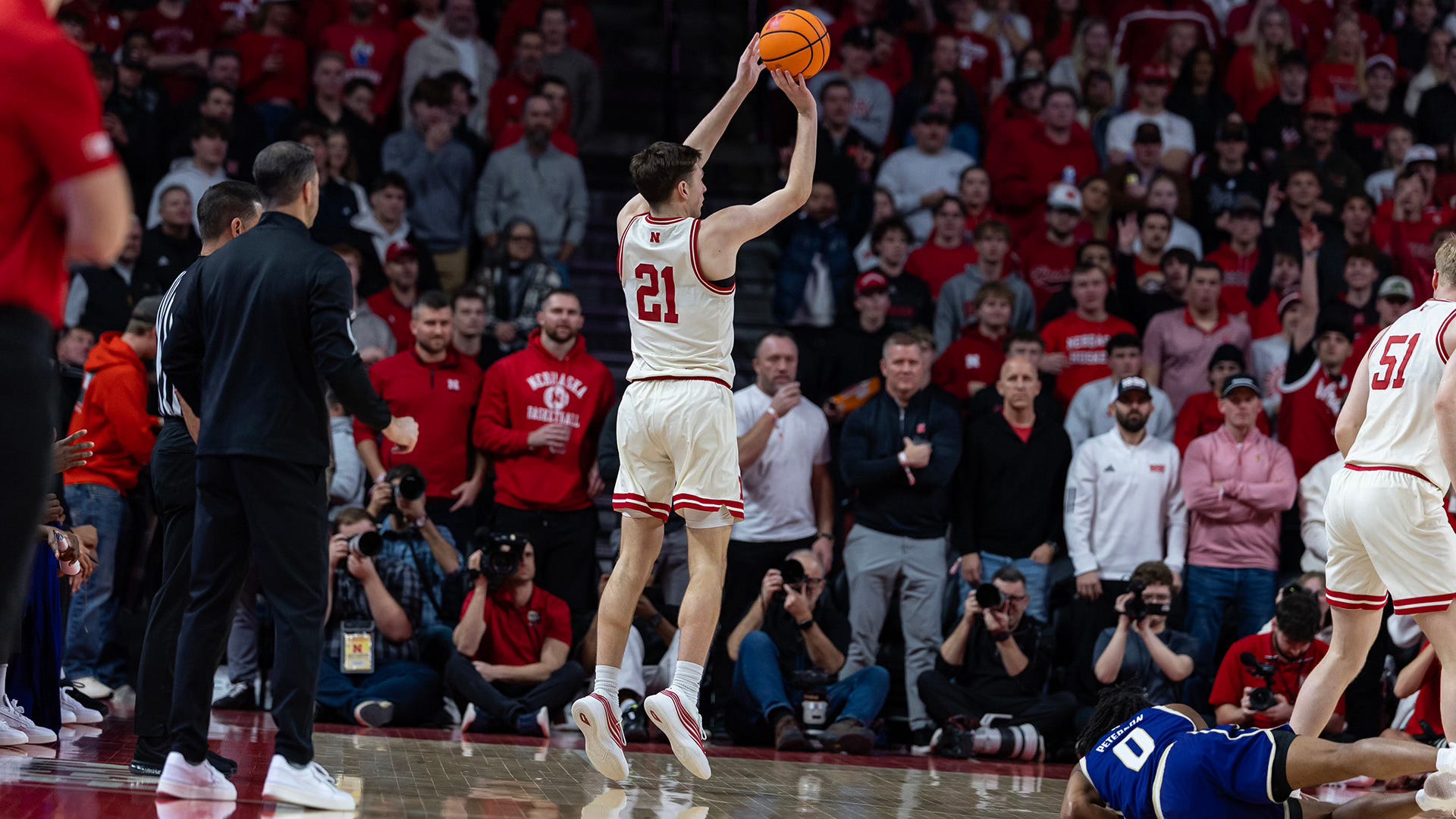
This college basketball season is weird. Not only because Nebraska climbed into the AP top-5 for the first time in program history, though the Huskers are part of this other weirdness, too.
Over the previous nine seasons, exactly three high-major teams attempted more 3-pointers than 2-point field goals for an entire season: 2017–18 Washington State, 2018–19 Villanova and 2023–24 BYU. This year, seven high-majors were more-3s-than-2s through Feb. 7, part of 18 teams overall.
Nebraska, with its 3-point rate of 50.9%, is in that group thought it only ranks fourth in the Big Ten, trailing Illinois (51.2), Indiana (51.2) and Wisconsin (51.0). Louisville (53.9) is as 3-happy as we’ve seen a power-conference team be in the past 10 seasons, Alabama (53.4) isn’t far behind, and Florida State (51.1) isn’t winning a ton of games, but the Seminoles are taking a bunch of 3s in their first season under head coach Luke Loucks.
So, what gives? I can only theorize, but it’s a theory that involves the collision of a few popular narratives.
Over-optimization
It’s not like the “rise of the 3-pointer” is a new trope. We’re so deep in it now that teams valuing the long ball over almost any other shot is most likely mentioned as an analytics-driven, over-optimized negative, particularly if you follow the NBA. But an NBA team didn’t cross the 50% threshold until Houston did it in 2018–19. Three seasons before that, no team was above 40%.
But that famed Princeton team that knocked off defending-champion UCLA in the 1996 NCAA Tournament? My memory was it was all about backdoor cuts and the “Princeton offense,” but that team also had a 48.1% 3-point rate. A year later, the Tigers crossed 50%.
Despite the head start on 3-point madness, the last 10 years show that it remained mostly a fringe strategy with 45 of the 55 teams to shoot more 3s for an entire season coming from outside the high-major ranks.1
Right now, seven high-majors are choosing the triple option, and, by Team Rankings’ projections as of Sunday, six of them had a better than 90% chance of making the NCAA Tournament.
Which introduces another familiar narrative…
Live by the 3, die by the 3
Winning now is great but win enough now and all that matters is winning in March. This is rare, but Nebraska’s in that group, too, right now. Normally in February observers are wondering if the Huskers will make the tournament and end their reign as the only major-conference team without a March Madness win. Today, NU is a lock to make it and, as a projected top-four seed, will be expected to end the streak. This is sort of alarming to admit, but until the streak ends it might be the only thing that matters this season.
Nebraska has the team to do it, and it has it right now.

But are 3-point teams inevitably limited by the inevitable cold night? We don’t have a ton to go on from the 10-season sample in terms of high-major teams. Washington State was 12-19 in 2017–18 and didn’t sniff the dance, but 2018–19 Villanova won the Big East regular season and tournament titles and earned a 6-seed before losing to 3-seed Purdue in the NCAA Tournament. BYU also earned a 6-seed in 2023–24 but was bounced in the first round by Duquesne and then lost its head coach to Kentucky.
Not the most encouraging track record, but a small sample size. The main takeaway here is we haven’t seen this many power-conference teams in this position at the same time. Some of these teams will win in March, and it won’t be enough to defeat the “live by the 3…” narrative.
Clichés are hard like that.
The unifying theory
Football drives the college sports discourse and as such, Indiana’s national championship is probably always going to be example used to explain our current NIL and transfer era.
But don’t rule out basketball’s potential contribution to this trending topic in 2026. We know more high-major teams are using what would’ve previously been considered a small-ball, looking-for-an-edge strategy. Yet we know these teams are among the most advantaged in the NIL landscape.
Indiana football’s two-year run was often dumbed down to, “Well, they were right in the transfer portal.” The most reasonable counter-narrative to that remains, “Well, maybe they just had a forward-looking plan—which included the portal—and executed it.”
We can’t say that yet about shooting more 3s than 2s as a high-major in college basketball, but we can at least look at it.
And, right now, Nebraska’s part of it.
If you really love 3-pointers, the Southern Conference is your conference. The SoCon has 11 teams on our 10-year list, and another three that were once members.
I realized today, during lunch, that if the Pats hadn't scored, their QB would have had to change his name to "Maye°". (may naught).