


The sun rises earlier now?
My 5-year-old had been up for two hours Sunday when I pointed out how much lighter it was shortly after 7, when we usually leave for school. I tried to explain that nothing had changed with the sun, just the timeframe was intentionally shifted. As tends to happen, it quickly got away from me and long after he’d moved on to other questions, I was still thinking it’s all kind of arbitrary, isn’t it?
Here’s an arbitrary timeframe for Nebraska football—Blackout 1 to Blackout 2. The games were separated by 364 days, but the bookends are spookily similar.
Blackout 1: Nebraska is 6-2 and hosting ranked USC for a splashy night game. All week, Nebraska makes a big deal of the blackout and the uniforms.1 It announces a contract extension for Matt Rhule. It’s a buzzy week and NU still has the opportunity to write a great ending to the season. The Huskers lose their starting quarterback and lose the game, 28-20, but I thought it was the best they played all season. The four games that followed came nowhere close to challenging for that title.
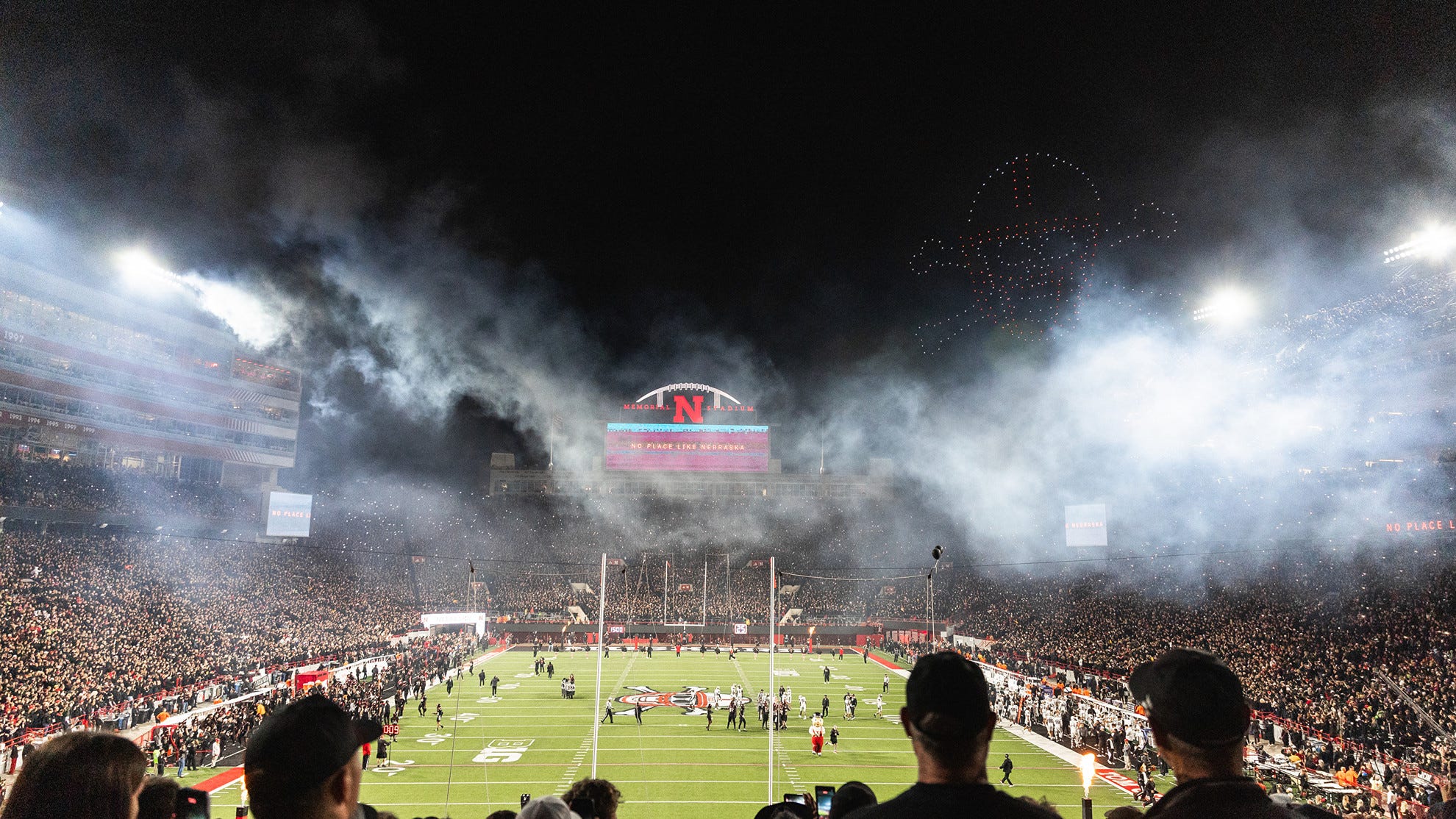
Blackout 2: This past Saturday, Nebraska is 5-2 and hosting Washington, a wilting preseason ranked team. All week, Nebraska makes a big deal of the blackout and the uniforms.2 Its starting quarterback, Anthony Colandrea, announces his own contract extension, or at least his agent does. It’s a buzzy week and NU still has the opportunity to write a great ending to the season. Despite leading 10-3 with 1:49 left and having the Huskies in fourth-and-18, Nebraska loses.
It was, I believe, the worst loss of our adjusted timeframe. Penn State last year was uglier, and losing to Iowa might still hurt more, but Blackout 2 was a loss so contextually painful, I’m not even sure it’s possible to completely survey the damage yet.
But don’t take it from me. Instead, just pay attention to All-Big Ten center Justin Evans, who delivered the most shocking quote after the game.
“We have to keep our head coach up,” he said. “We have to keep him going.”
Not sure I’ve ever heard a sentiment similar to that after a football game.
My reaction: Oh, it’s worse than I thought.
But that makes sense inside our timeframe, a period when Nebraska went 6-7. The wins included Ohio, Bowling Green, North Dakota and the bottom of the Big Ten. The losses were all conference losses—minus a bowl game blowout to Utah—and all would’ve meant something more than any of the wins…if they weren’t losses.
Following 2025’s 1-4 finish, Rhule effectively closed ranks—no more podcast, no more McAfee Show, still open to any question at press conferences, but very often saying less. They were actions that said he knew talking couldn’t change anything, only the games could and there’s no adjusting the timeframe for those.
When the games did arrive, Nebraska looked great through five games. Game six was a loss to Indiana but was perhaps the best proof yet—on the field, at least—that the Huskers might have something in 2026.3
To that we add two more fourth quarter collapses to opponents of decreasing quality and increasing pain, and now we might be at a real turning point of this tenure.

Maybe it’s unfair to compare the program with the most joy of the past three seasons, Indiana, to the major program with, maybe, the most suffering over that span, Nebraska.4 But consider these two Octobers.
Indiana enters the month 4-0 and proceeds to:
Crush Rutgers, as expected.
Beat Nebraska, 20-17, despite having a win probability as low as 20% in the fourth quarter.
Be a few inches on the final play from beating Ohio State despite having a fourth quarter low of 10%.
Beat Michigan, 13-6, with a fourth quarter low of 34%.
Beat Minnesota despite a low of 24% after the Gophers hit a late 60-yard field goal. IU answered with its own 60-yarder and won in overtime.
Nebraska enters the month 4-0 and proceeds to:
Trail Maryland deep into the second quarter before a pick-six changes the flow of the game. The final score, 48-23, looks as expected.
Lose to Indiana in the fourth quarter, despite that 80%-win probability after Colandrea’s touchdown.
Lose to Oregon despite a win probability as high as 79% in the fourth quarter.
Lose to Washington, amidst all the glitz, with a fourth-quarter high of 89%.
It’s easy to spot the difference there, harder to identify the fix. After the Indiana loss, Rhule noted that Nebraska was in the Hoosiers’ class, and that was how it looked.
Two games later, based on Evans’ comment, any such feeling might be gone. It’s a scary thought.
Definitely the scariest thing I experienced this Halloween.
“I understand exactly how people think, and how passionate they are, how frustrating three games in a row like that are,” Rhule said. “All I can do is show up tomorrow and get back to work for Illinois, try to have a great November, try to have a great this week, and that’s what I’ll do.”
It is sort of all one can do given the context.
I don’t know how early Rhule arrived at Memorial Stadium Sunday. The sun rose, but on its own schedule. Hopefully, however, he noticed it was a bit brighter than he’d gotten used to on recent Sunday mornings.
The short-term future of Nebraska football might depend on it.
As I wrote then: “These are normal things all college football teams do but given the Huskers’ recent history of coming up short in big moments, drawing extra attention to yourself has often felt like angering the humility gods.” Given I thought this was a good performance in a loss, the gods weren’t too angry.
The gods must’ve been pretty angry. (I’m pro-blackout, for the record.)
It’s still the best team of the Rhule era at this moment, but there are four games left.
And we could easily expand the range here for NU’s period of suffering, but who wants to do all that?