


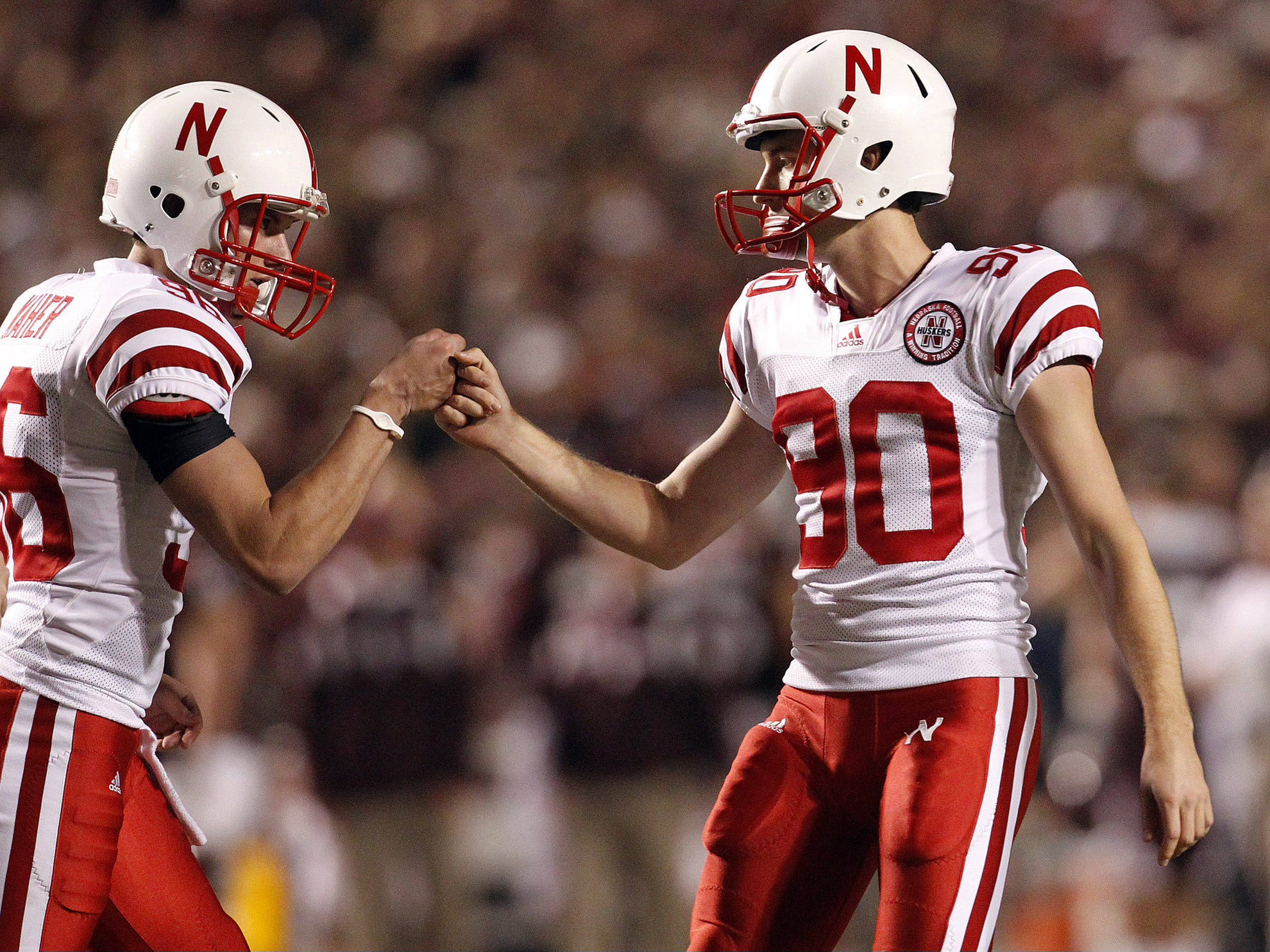
It’s possible you don’t remember how good Alex Henery was. You remember his 57-yard kick against Colorado in 2008, of course. Trailing 31-30 and facing fourth-and-25 from the CU 40, Nebraska has no choice but to try to make a kick no Husker has made before. This is not a leisurely September swing against San Jose State. No, it’s a rivalry game and it’s already after 5 p.m. on this day near the end of November. This is a prayer uttered into the cold, dark night.
Except it isn’t. You didn’t have to pray a lot on Henery’s kicks. I say it’s possible you don’t remember how good he was because I didn’t remember until I had occasion1 to dig through his Husker résumé. And now I’m on a mission.
There are two kickers in the College Football Hall of Fame. Kevin Butler was the first, inducted in 2001. A home-state hero, Butler kicked at Georgia from 1981 to 1984, making 77-of-98 field goals. He left the college game with the NCAA record for accuracy beyond 50 yards, making 52.4% of those attempts.
Jason Hanson is the second kicker in the Hall. He too stayed home for college, attending Washington State from 1988 to 1991, where he made 62-of-95 field goal attempts. Hanson departed Pullman as the NCAA’s career leader in makes beyond 40 and 50 yards.2
Butler and Hanson were both consensus first-team All-Americans—a requirement for consideration for the Hall of Fame—but neither won the Lou Groza Award as it didn’t exist until 1991.
Henery didn’t win that award either, which is a wrong we can only right by pushing for him to be inducted into the Hall of Fame. As you’ll see, his résumé more than stacks up.
Here’s the basic case you can make for Henery’s inclusion—he’s still the most accurate kicker in the history of FBS football. Henery made 68-of-76 field goals (89.5%) over four years in Lincoln. That’s still the NCAA record entering the 2026 season. As our first basic spot check, let’s compare that to Butler and Hanson while knowing that not all field goal attempts are created equal.
Now let’s dig a little deeper. Henery scored 204 points on 76 field goal attempts, an average of 2.68 points per attempt. A kicker who never missed could only average 3 points per attempt, which is obvious but important to note. Whether it was a 17-yard field goal or a 57-yarder, Henery delivered almost 90% of the points available3 no matter what. Here that is against our two current Hall of Famers.
Next, we establish a baseline for measurement using College Football Data’s Points Added Above Replacement (PAAR), which uses actual makes and misses from 2016 to present to produce an expected point value for a kick based only on distance. Henery’s 76 field goal attempts had an expected value of 164.5 points. He produced 204, meaning he was 24% better than expected.
One of the things I was most looking forward to doing this summer4 was compiling every college field goal Butler and Hanson ever attempted. It’s here I admit that I tried and failed. I started down that path by finding the official stat sheet from Butler’s first game5 in 1981. When I saw that the sheet included the handwriting of whoever the official scorer was that day, two realities became obvious: a) either I’m never going to find all of these kicks, or b) it’s going to take me a month. So, I regret to inform you6 that I do not have the career PAAR for Butler or Hanson.
But I think we can still use the data we have to ballpark this in a compelling way.
Let’s stop to actually think about kickers for a second. Should accuracy be the most important trait? It’s hard to argue against this, but, if we’re being honest, making a 30-yard field goal isn’t that exciting. Or, as I’ve put it previously:
The craft itself is underappreciated by default. Teams settle for field goals, that’s the saying. They don’t settle for field goal attempts. The 3 is assumed because drive negotiations started at 7. But, fine, 3.
Long kicks, however, are exciting. Based on the brief biographical sketches previously you might assume Butler and Hanson had a leg (ahem) up on Henery in terms of sheer power. And maybe they did, but here’s what I can tell you for certain.
The average length of an actual Henery field goal attempt at Nebraska was 36.5 yards. On those kicks, he averaged 2.68 points per attempt. Returning to PAAR, our baseline which includes all FBS kicks since 2016, you would expect a return of 2.68 points on a 26-yard field goal.

To put it another way, based on actual points produced, Henery made every field goal attempt as certain as one snapped from the 9-yard line, where FBS kickers have made 89% of their kicks since 2016. This despite the actual average distance of a Henery field goal at Nebraska being basically a 37-yarder. This walk-on from Omaha Burke could basically gobble up 11 yards all by himself, and if you think about what this means—one fewer first down needed, or one more added—it feels like a superpower. If Nebraska had a running back worth 11 yards a touch, it wouldn’t lose unless that back was prone to fumbling.
Butler averaged 2.35 points per field goal attempt, a rate that equates to his average attempt being from 35 yards out. Could that have been his actual career average? Certainly possible. That’s not far off Henery’s number and Butler was really good, which I learned as a child thanks to my stellar record playing with Chicago in Tecmo Bowl.
Hanson was also obviously very good, but his HOF comparison with Henery’s case largely comes down to leg over accuracy. Hanson averaged 1.95 points per attempt, which would’ve been what you’d expect if the average distance of his field goals was 42 yards. Is that possible? Maybe, but it seems unlikely. We know that 63% of Hanson’s makes were from 40-plus yards, so it’s possible Washington State wasn’t afraid to throw him out there on drives that stalled outside the red zone while also not needing him a lot once in the red zone.7
Point is Henery’s Nebraska numbers more than stack up. He was more accurate than either Butler or Hanson. Maybe both had an ability to kick the ball farther, though we should note that Henery was 6-of-11 on attempts of 50-plus yards (52.3%).8 That’s a tenth of a percentage point behind the NCAA record Butler set when he left Georgia following the 1984 season. Henery destroys Hanson when it comes to accuracy.
To be considered for the College Football Hall of Fame a player must meet the following criteria:
Be a first-team All-American by a major selector. ✅
Be out of the college game for 10 seasons. ✅
Be a decent citizen. ✅
Have played in the last 50 years. ✅
Be nominated by the current AD, head football coach or SID.❓
I don’t know if Nebraska has nominated Alex Henery for the College Football Hall of Fame. If you’ve been persuaded it should, feel free to spread the word.
The mission has begun, and now you’re part of it.
What’s the occasion? I am once again happy to be a featured guest on the Common Fans summer podcast series. We’re creating a few Mount Rushmores for Husker football before settling on the final one. The episodes on the Rushmores of coaches and quarterbacks are already out, with the special teams episode (defense and walk-ons, too) coming later this month.
Hanson made 39 kicks of 40-plus yards, 20 of which were from 50 or beyond.
As a reward to the footnote readers, here’s a mind-blowing fact: Henery averaged 2.91 points per field goal attempt inside 50 yards. He was virtually automatic, going 63-for-65. The expected points, based on PAAR, for 17-yarders—the shortest field goal you can measure as the ball has to be inside the 1—is 2.85. Henery was better than that on all of his kicks under 50 yards.
I wish I were kidding.
He made 3-of-4 field goals as Georgia destroyed Tennessee, 44-0.
Still not kidding. Nobody is as bummed about this as me.
The latter seems unlikely given Washington State was 22-23 during Hanson’s tenure. That’s a team that needs the kicker more than it doesn’t.
If you’re a fan of “development” as a concept we could also note that Henery started his Nebraska career 1-of-6 from 50-yards-plus, the lone make being the 57-yarder against Colorado. Starting with a 52-yarder against Texas in the 2009 Big 12 Championship game, he would finish his NU career 5-for-5 from 50 yards or more.
okay, THANK YOU. It's so silly to consider his NFL career when thinking of him as a Husker and a college athlete, but I feel like so much of the discourse is drowned out by noisy Eagles fans (in the times he comes up in discussion)