


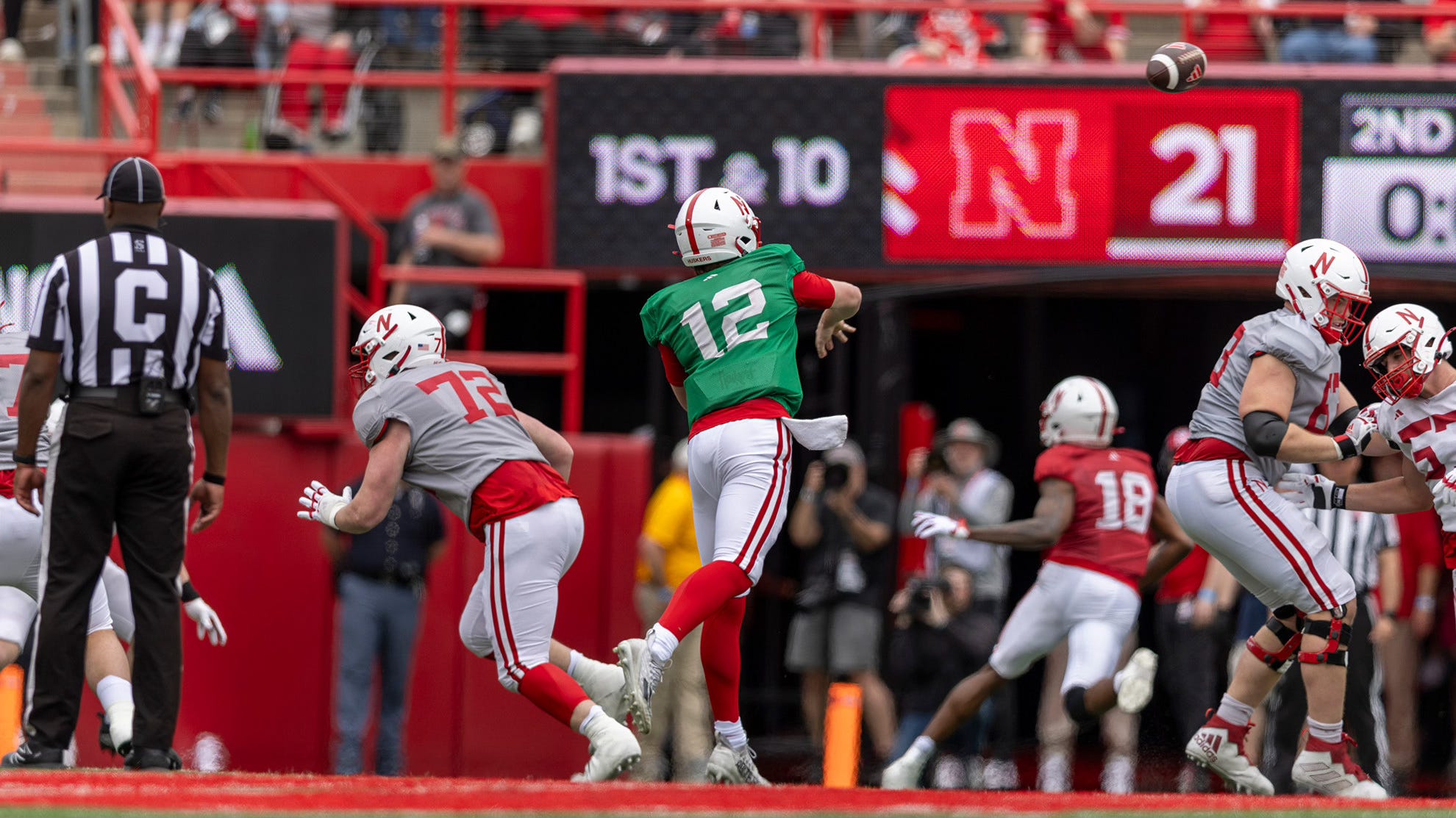
You never know until you know, but I’m reasonably confident saying Nebraska did well addressing its quarterback situation via the portal. We won’t actually find out until fall, but the Huskers were facing a tough putt after the departure of two-year starter Dylan Raiola (and third-stringer Marcos Davila).
That left TJ Lateef, the starter over the final four games following Raiola’s injury, but he was the only scholarship QB on the roster for 2026 when the portal opened. He had, and has, the incumbent’s advantage in the battle set to unfold this offseason—knows the team, knows the playbook, knows what November Big Ten games are like. Minus the like-clockwork starting debut against UCLA, however, the lengthy look at Lateef—just a true freshman—was inconclusive.
Was he the starter in 2026? Did NU need to recruit over him in the portal? Just add depth? No matter the answers to those questions, whatever Nebraska decided would always fall under the category of “competition” because competition is Switzerland, football’s neutral state that no one can question or complain about.
But with two portal additions, Nebraska and Matt Rhule checked both the experience and depth boxes. It took a false start with Kenny Minchey to get there, but in landing Anthony Colandrea, off a season at UNLV that saw him win Mountain West Offensive Player of the Year, the Huskers added more production and veteran savvy than they had.
Welcoming home Daniel Kaelin from a season spent as the backup at Virginia was about as good as looking for additional depth was going to realistically go. Nebraska obviously could project Kaelin, an Elite 11 participant, as a future starter when it signed him out of high school in the 2024 class. Most observers will slot Kaelin third on the depth chart to start the spring—and that’s where he’d fall based on production so far—but, if that’s where he falls, I doubt there are more than a handful of teams in the country with more raw talent at third-string.
As additional insurance, Nebraska made the late add of Tanner Vibabul to the 2026 recruiting class. A 3-star bullet train out of Las Vegas, Vibabul had a handful of Group of Six offers and might be more runner than thrower, but he does appear to get up to full speed as quickly as anyone I’ve seen since Taylor Martinez.
This all should set up well. For right now.
But the Huskers’ rapid revamp of the QB room does make me wonder about the long-term future at the position.
And the state of the game today makes me wonder if having a long-term plan at quarterback is just time wasted.
Anthony Morales of The Athletic explored the latter the issue in a recent story titled “Why don’t college programs develop quarterbacks anymore?” The most pertinent quote for our purposes may have been this one:
“There is no such thing as a build,” a Power 4 head coach told The Athletic. “You may go from being undefeated to being on the hot seat in 12 months. So, this era just forces you to constantly win, which removes the ability to have growing pains with a young quarterback.”
Rhule, by his own admission earlier this month, chose a different path at QB two years ago when flipping Raiola in December 2023.
“When we took Dylan, we had visits set with Sam Leavitt, with Cam Ward, with Kyle McCord…and I went the young-player route,” he said. “Now when you look at college sports, and when you look at Indiana, it’s probably not the way to do it anymore. It’s probably to get an older team, to play with a veteran quarterback.”
To be clear, he had to do that. You don’t turn down the 5-star son of a former Husker All-American if he wants to come. Rhule pushed ahead with that plan confidently and now feels differently after two more seasons of data.
That decision produced back-to-back bowl trips, a disappointing departure and a portal scramble to rebuild the QB depth this January. But it might keep reverberating all the way through next January.
Let’s say Colandrea wins the job in 2026 (and I’d make him a moderate favorite to do that). He has one season, which seems like an advantage from a future-depth perspective by conventional logic. But we’re at a time and place where every offseason seems like it’s going to be spin the wheel at quarterback. It’s not crazy to envision a January 2027 where either Lateef or Kaelin seeks more certain playing time elsewhere, leaving Nebraska with a comparatively inexperienced upperclassmen as the de facto favorite to start competing with the redshirt freshman project Vibabul and a potential portal addition.1
Unless the answer to the “what’s the long-term future at QB” question is true freshman Trae Taylor. He went from being intensely committed to NU to super committed last week when he announced he’s moving to Lincoln (to play in Omaha) for his senior season of high school. In our past lives of college football, this would make decent sense.
In our current lives, however, it would represent the same decision Rhule had to make at the end of 2023—go young and live with youth or stay on the transfer-QB hamster wheel? Popular opinion and recent results favor the latter. Rhule, recently, does too.
But this is going to be hard again in a year.
Maybe Nebraska has so much success in 2026 the decision ends up being easy. Maybe it has so little success that there’s no decision to be made.
Maybe it’s silly to even be considering what today’s QB situation at Nebraska might mean two or three years down the road.
No matter the answers there, the Huskers’ current and future QB shuffle makes me realize how little how much we used to know about college football success matters right now.
In this scenario, which seems the most probable to me, it would be advantageous to Nebraska if either Lateef of Kaelin won the job in 2026. I’ll be surprised if that happens.