

We wait all offseason for some real information. Due to the anticipation, maybe it’s inevitable that we’ll do too much with the first bit we get. Or too little. It can go both ways.
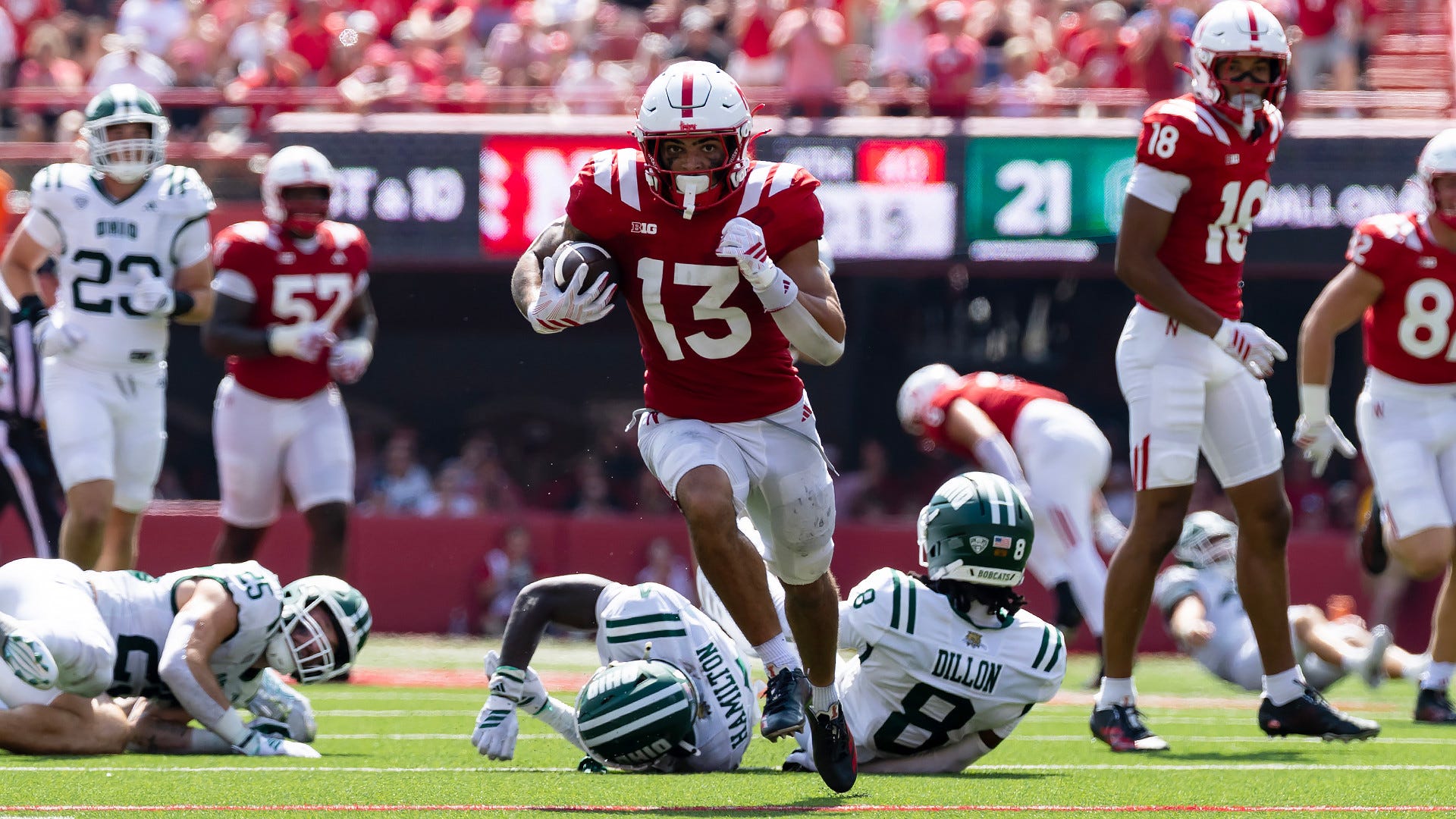
I spent the first half of Nebraska’s season opening 49-21 win over Ohio thinking these new Huskers didn’t look much different from their immediate predecessors—unforced errors, decent offense without much of a calling card, uneven line play on both sides. I spent most of the second half—minus yet another dreadful offensive drive out of halftime—thinking maybe this NU will be different thanks to in-game defensive adjustments, a strong running game with multiple contributors and maybe the right quarterback for right now.
All those ideas are potentially valid, and that’s the trick of Week 1. It’s the most information we’ve had to this point. In six days, it will be the least amount we have the rest of the year.
Context gets overlooked over opening weekend. That’s the anticipation, too. Fans can’t wait to watch their teams and then process and discuss what they saw. Beyond looking at the scores, there’s not a lot of room to consider what’s happening everywhere else.
Unless you keep reading this newsletter, of course. Let’s try to put some context to the Huskers win and some of what we saw.
All 18 Big Ten1 teams were in action in Week 1. The opening slate across the country does offer a good bit of commonality in that most power conference teams are playing a team they’re expected to beat handily. Nearly half the Big Ten was expected to win by between three and four touchdowns. The teams and opponents are different, but a lot of these games are kind of the same.
So, let’s start there. The table below includes each Big Ten result from Week 1 along with how the Big Ten performed against expectation (i.e. the spread) and—using Bill Connelly’s majestic2 Top 772 ratings, which ranks every NCAA and NAIA team in one list—the overall, offensive and defensive ratings for the Big Ten opponents. The darker the shade in those last three columns, the less resistance a team was projected to face.
Nebraska’s 49 points Saturday were the second-most3 it had scored against an FBS opponent in the Matt Rhule era. The Huskers’ 523 total yards ranked fourth in the Big Ten4 and they were one of five conference teams to score a touchdown on every red zone opportunity. This all came against the seventh-best defense any Big Ten team faced in Week 1. The team one spot ahead of Ohio in the Top 772 ratings, Western Michigan, held Michigan to 13 points.5
The Blackshirts had an easier projected path against just the 12th-best offense to face a Big Ten team this weekend. At 303 yards allowed, NU ranked 10th in the conference after one game, though more than half those yards came on the first three drives in a game that included 12 possessions for Ohio.
The social media barbs were flying as Nebraska stumbled to a 14-13 lead over Ohio, but its fourth quarter surge helped the Huskers exceed the market expectation slightly. It was enough to put NU in the top half of the Big Ten for Week 1.
Some of the time there’s value in zooming in. Most of the time, I’ve found, there’s overlooked value in zooming out. Bottom line: Nebraska won about as expected while facing a defense slightly above and an offense slightly below the conference averages for the week. In 10 of the 11 main statistical categories at Game on Paper, Nebraska ranked at or above the 77th percentile compared against all FBS vs. FBS games in 2025.
You’ll take that6 in an opener. On to some individuals…
Anthony Colandrea
I didn’t see a lot to take issue with in the transfer quarterback’s NU debut. Colandrea was a little off his typical completion percentage at 18-for-32 (56.3), but I benchmarked 8.5 yards per pass attempt as a good day going into the game and he finished with 8.6 and three touchdowns. His air yards per throw (depth of target), 7.1, was about average nationally7 for Week 1, but at 9.2 average yards after catch,8 Colandrea ranked ninth among the 320 QBs with at least 20 attempts. Most of the credit might go to the receivers there, but some of it goes to the QB for the putting the ball in places where the pass-catchers can run.
Colandrea also made what felt like a reasonable number of plays with his legs. Take out two sacks and he rushed for 48 yards on eight carries (6.0), including a 13-yard touchdown. Overall, Colandrea’s 0.502 Expected Points Added (EPA) per play ranked 66th out of 320 QBs playing Week 1. Not jaw-dropping, but plenty good enough.
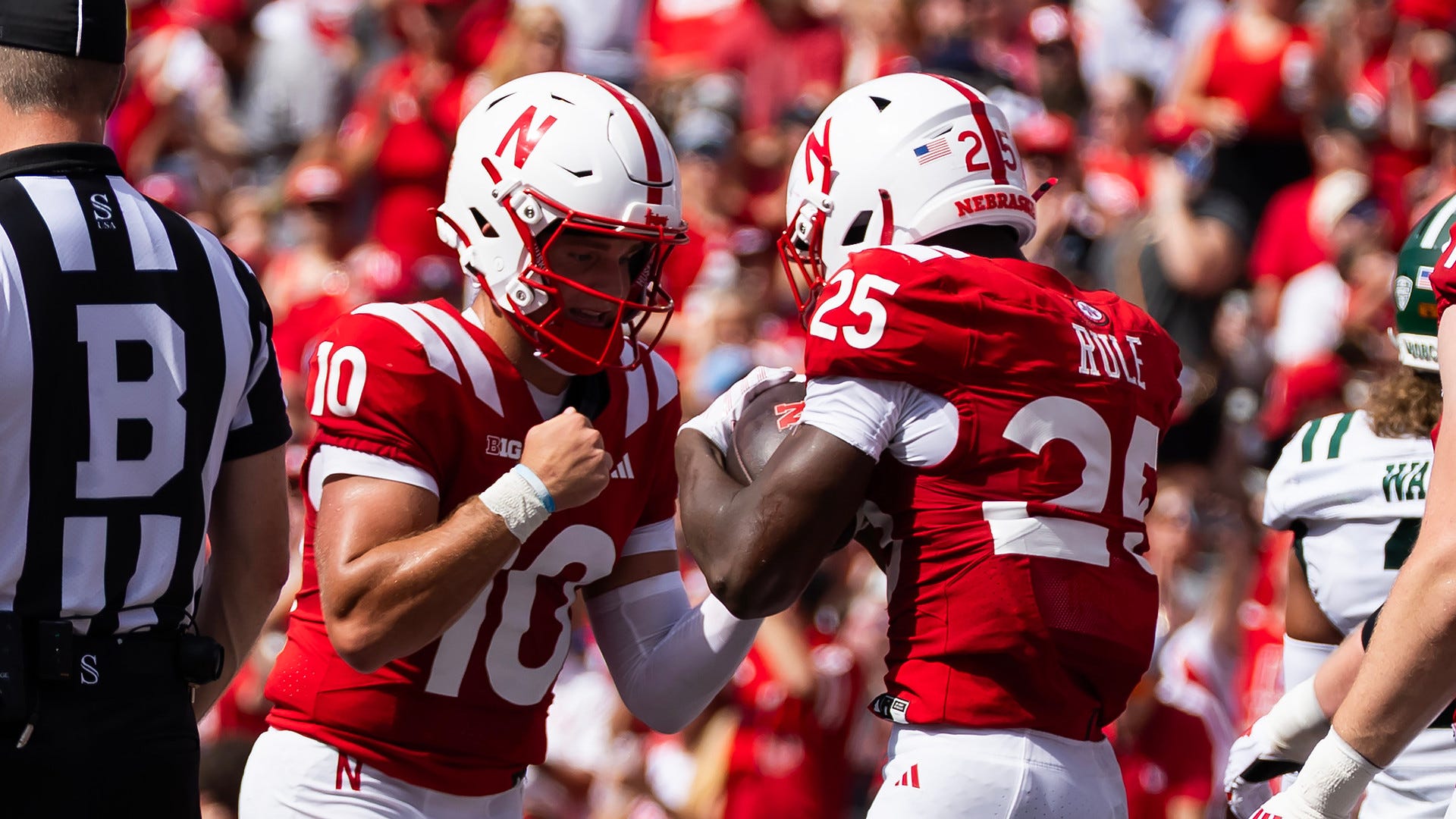
Jamal Rule
You won’t stop hearing about the freshman this week, and it’s merited. Rule carried 15 times for 122 yards with two touchdowns, averaging 8.1 yards per carry. He also made two catches for 47 yards, and scored that way, too.
Roll it all together and Rule averaged 1.151 EPA per play. That ranked third among the 409 backs with at least 15 total touches. Rule trailed Iowa’s Kamari Moulton, who rushed for 183 yards on 11 carries in a 40-0 win, and Nevada’s Dominic Kelly, who tallied 152 yards on 11 carries in a 49-14 win over Western Kentucky.
Against a defense that’s expected to be something this year, Rule helped power Nebraska to 248 rushing yards, the second-best total of the Rhule era.
B1G winners, losers & others
I’m taking more of a conference-first approach this season for two reasons: 1) it’s 75% of the games a Big Ten team is guaranteed to play, and 2) it’s where NU has fallen mostly short so far under Rhule (and for most of the past decade).
Winners: UCLA gets my top honor this week, beating Cal 45-24 in an impressive debut for Bob Chesney’s new team. Northwestern isn’t far behind after pulling away from a dangerous South Dakota State team. And maybe this was because it was on Friday night, but hat tip to USC which blanked what should be a good Fresno State team, 3-0. The Trojans are already 2-0.
Losers: Rutgers, obviously. The Scarlet Knights lost to UMass as nearly a 30-point favorite in what was probably the Minutemen’s biggest win as an FBS program. Rutgers will only be favored in one game the rest of the way, a Sept. 25 visit from Howard. Michigan controversially beat Western Michigan on a Hail Mary, but the Wolverine offense was dominated by its MAC opponent. Plenty of time to change things, of course, but this was a serious sign of trouble. Quarterback Bryce Underwood was 12-for-22 for 170 yards, but that includes a 50-yard Hail Mary.
Others: This is the category for the teams that were mostly fine, which includes Nebraska, though I’d put the Huskers at that designation with a slightly upward trend based on one game. Iowa scored more points than I thought it would against NIU. Illinois allowed more points than I thought it would against UAB. Oregon looks like an underachiever by the spread for a 7-point win over Boise State, but maybe the Broncos are just good…again. Not worried about the Ducks. Sunday’s Apple Cup was a mildly surprising scuffle for ranked Washington. Wisconsin hung tough for a while against Notre Dame at Lambeau Field—maybe a sign of life in Luke Fickell’s fourth season—before it looked like it was expected. Finally, Maryland played Hampton, the only game I have no thoughts on.
I listened to a bit of the Ohio pregame broadcast Saturday morning, and they called it the Large 18. Got a smirk out of me.
Where else could you project a line on Ohio State, the top team entering Week 1, facing Maine Maritime, the worst team? It would be Buckeyes -153, but if you make Ohio State visit Ritchie Field in Castine you can drop that to -150.5.
Unlike last year’s Akron game—the one the win over Ohio trails—Nebraska needed to strain for these 49.
Wisconsin-Notre Dame was still pending as of this writing.
Or 7, depending upon your point of view on the end of that game.
Take this for what it’s worth, but NU jumped eight spots in ESPN’s FPI as of Sunday night. That allowed it to vault Iowa and Washington.
And closer to what NU averaged last season rather than closer to Colandrea’s number at UNLV.
Guess who led the country in this category? Kentucky’s Kenny Minchey. He was 18-of-27 for 301 yards and four touchdowns in the Wildcats’ 45-13 win over Youngstown State.