


The NCAA basketball tournament selection committee released its first bracket preview Feb. 21, announcing the top-16 seeds as things stood as of late morning on Saturday. Poetically, five of those teams then lost later that day.
Michigan, No. 1 in the AP poll and the bracket preview, fell to No. 2/3 Duke, and No. 4/3 Arizona went on the road and beat No. 2/6 Houston. No shame in either loss, obviously, but there were surprises down the list. No. 8/10 Kansas suffered its worst home loss to an unranked team in decades, falling to Cincinnati, 84-68. No. 10/7 Illinois lost in overtime on the road at UCLA.1 Less of a shock, but still a loss: No. 6/4 Iowa State fell at No. 23 BYU.
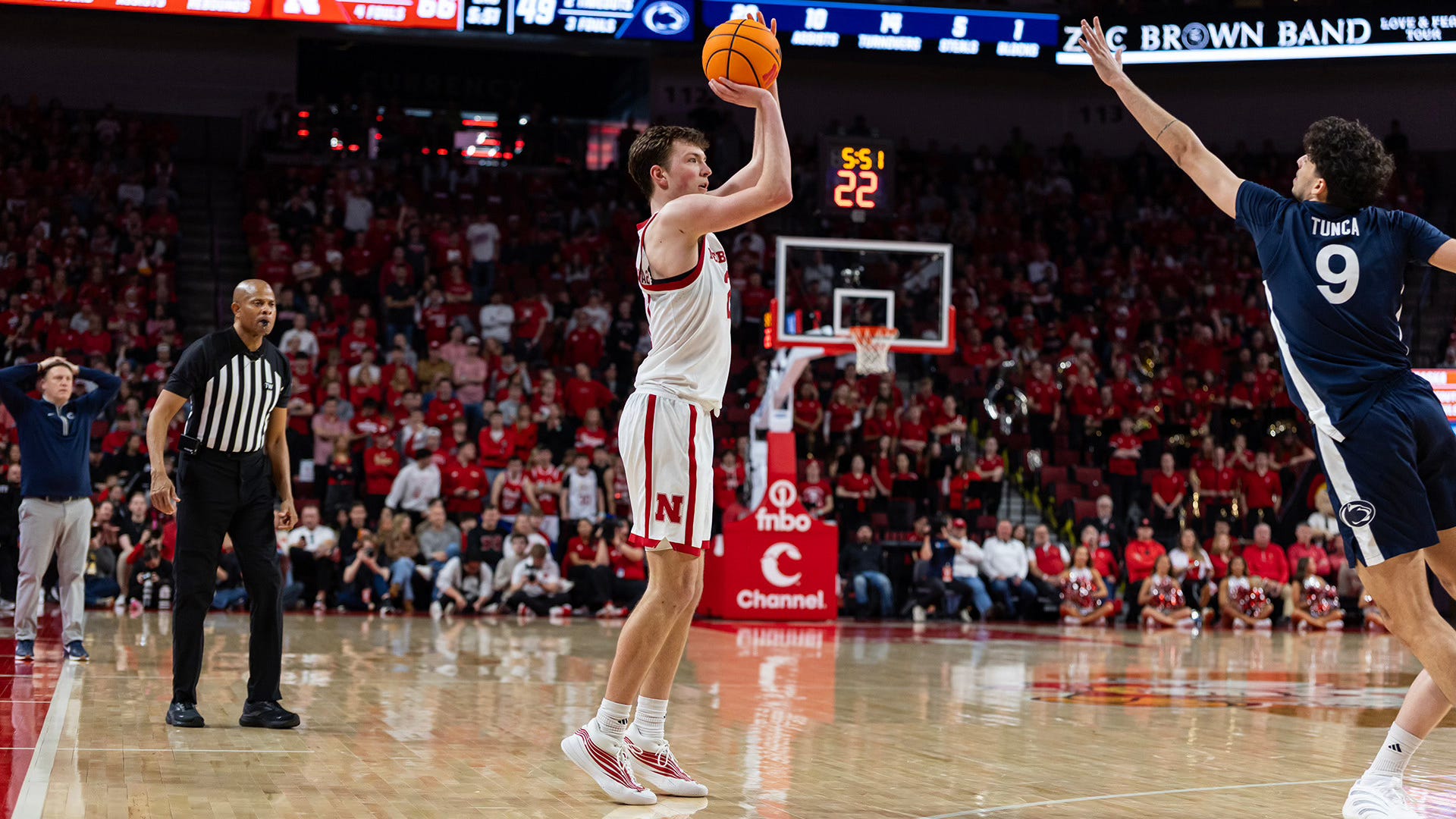
Nebraska avoided the curse by calmly dismantling Penn State behind 33 points and a school-record eight 3-pointers from Pryce Sandfort. The Huskers, ninth in last week’s AP poll, were 11th overall by the committee. That projected NU as a 3-seed and resulted in a prospective spot in the South Region with 1-seed Iowa State,2 2-seed Connecticut and 3-seed Texas Tech.
It’s all just theory at this point, but I enjoy these theoretical rankings much more than the weekly updates from the College Football Playoff committee. Why? They’re less frequent, for starters, but the real reason is the hoops hierarchy actually points to something.
Increasingly, that something is WAB.
The NCAA introduced Wins Above Bubble last year for use by the selection committee, and the field that group selected had a strong WAB correlation. That was true of this year’s first bracket preview, too, with WAB topping the other six metrics in official use by the NCAA.3
The beauty of this metric is its simplicity. You set a bubble point—in this case it’s the 45th-ranked team in the NET ratings (VCU, for now)—and then let the model work to determine how many more (or fewer) wins a team has than the average bubble team would playing its schedule. You can forget strength of schedule and Quad 1 wins and all of that and instead focus on a single number applied against a common standard.
In Nebraska’s case—through the Feb. 21 games—it had 6.54 more wins than the average bubble team would playing the Huskers’ schedule. That total ranked ninth nationally. Michigan led the country at 10.43 and…I don’t know, just to choose another team at random for a better sense of scale…Creighton was 78th at -2.43.
If you enjoy bracketology, or simply watching a stock ticker, WAB has become where to go. Or, more specifically, the delightfully lo-fi wabwatch.com is where to go. There you can answer questions like, “How tough is Nebraska to beat at home?”4 Or, what will become a more pressing question soon enough, “How tough are the Huskers to beat on a neutral floor?”5
While WAB was strongly correlated with the committee’s initial bracket projection, it wasn’t directly correlated with the picks , and you wouldn’t want it to be. Particularly when the WAB-view was as potentially favorable for NU as it was this first go-round. The Huskers, with the ninth-best WAB that day, would’ve been under-seeded as a 3. The 1-seed, Iowa State, was just a spot ahead of Nebraska, while 4-seed Texas Tech was appropriately seeded, the Red Raiders unfortunately lost their best player for the remainder of the season last week. It cuts both ways, however, as 2-seed Connecticut would’ve been a 1-seed going strictly by WAB.
If you could lock in those top four seeds in Nebraska’s bracket right now, I think you’d take it. Of course, we can’t lock in anything right now, but it’s so rare for the Huskers to be in this position that I’ll be checking the stock ticker daily.
I’ll be checking WAB.6
Monday miscellany
After starting 3-1 with a couple of strong wins last weekend Nebraska baseball dropped its first two games of the Amegy Bank College Baseball Series—to No. 15 Louisville and the more traditional mid-week annoyance, Kansas State—but bounced back with a 10-1 win over No. 16 Florida State. Through two weeks, I think the Huskers can still come away optimistic for 2026.
No. 10 Nebraska softball is likely moving up in the rankings after a 5-0 weekend in California including wins over No. 13 South Carolina and No. 11 Texas A&M. The wins pushed the Huskers to 11-4 with one more five-game weekend ahead before the team makes its home debut March 5.
Reminder, Nebraska plays at UCLA March 3, three days after visiting USC. Both are Quad 1 teams. If the Huskers get a split on that extended trip, consider it a win.
This is when it dawned on me that if things hold relatively stable for both teams, of course the committee will put Nebraska and Iowa State in the same bracket. Who could resist a potential Elite Eight matchup of Fred Hoiberg versus his alma mater?
We’re talking about small differences here, but somebody’s gotta win.
Sunday night it was about the equivalent of beating North Carolina on a neutral floor.
Like beating Illinois on its home court.
As might be obvious, I’d be extremely in favor of the CFP committee adoption a similar, résumé-based method for comparing teams. In recent years Bill Connelly of ESPN has published weekly résumé rankings, but he uses “how many wins would a top-five team have against X schedule?” as his baseline. If the warring cabals in football ever decide on what future playoffs will look like, simply drop that baseline back to top-11, top-15 or whatever and we might enjoy some meaningfulness in football-bracket discussions, too.
Looking forward to the Cardi B ft Megan Thee Stallion remix of this column