


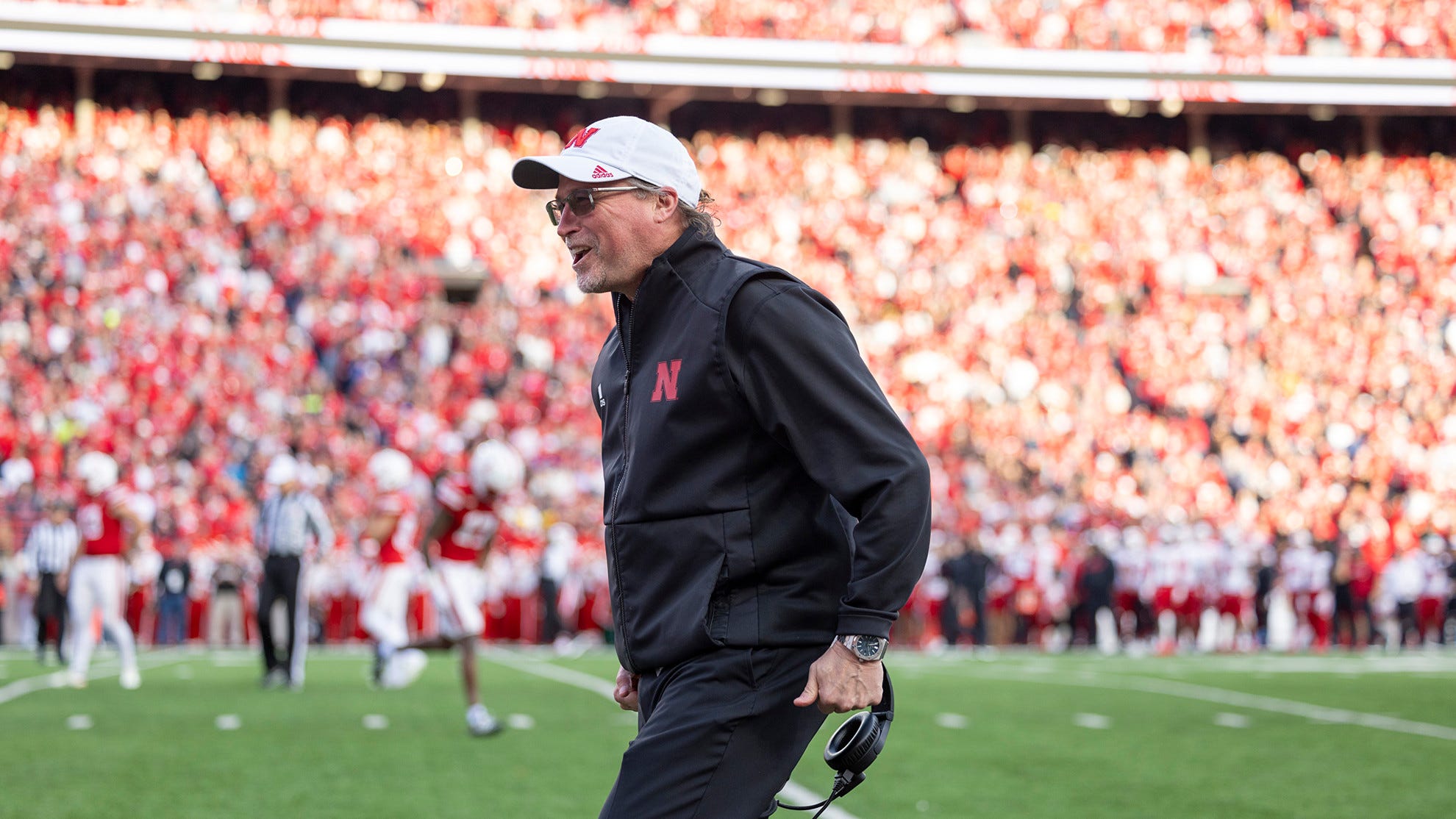
This is somehow easy to forget, but Nebraska offensive coordinator Dana Holgorsen was a head coach for 13 years before he arrived in Lincoln. A well-regarded coordinator off of Mike Leach’s Air Raid tree, Holgorsen coached eight seasons at West Virginia and five at Houston before making the odd November jump from an analyst role at TCU to be the OC at Nebraska in 2024.
That’s a lot of experience at the top level of college football. Bob Devaney coached Nebraska for 11 seasons and was a head coach for 16 seasons when you include five years at Wyoming. Holgorsen’s experience in the top seat isn’t far off that. Another, non-football way to put it: Holgorsen was a head coach for as long as The Walking Dead was on TV (2010–22). The show debuted and ended a year earlier than Holgorsen’s run as a head coach, but clearly he is Daryl Dixon in this story—an outsider, a free spirit, a survivor due to forced practicality.
So, here’s one of the biggest questions facing Nebraska in 2026: Is this the year we see vintage Holgorsen? He was hired for his track record and expertise. NU needed that in November of 2024, but if it had simply waited to make a coordinator change until the end of that season, would it have gone with someone from the Next Big Thing bucket, like what it did with Rob Aurich at DC this offseason?
Only Matt Rhule can say for sure, and he doesn’t have to because he made that decision what is now, technically, years ago (even though it’s only about 19 months old). But that’s old and context-rich enough to wonder if 2026 is the year we see some vintage Holgorsen?
When trying to make a broad comparison across multiple years, I prefer to keep the numbers similarly broad, so let’s look at yards per point. It’s a simple measure, exactly as described, that gives you an idea of how good an offense is at converting yards into points. A lower number is better and the best offenses in college football will turn about every first down—10 yards—into a point.
Holgorsen’s career high as a head coach came in 2021 when Houston averaged a point for every 11.8 yards gained, third nationally that season. In the Big Ten era Nebraska has only reached that level once, averaging the same 11.8 yards per point (6th) in 2014, which got the head coach fired. The Huskers haven’t finished in the top 40 nationally in this measure since. Over his 13 seasons as a head coach, Holgorsen’s offense was better than Nebraska’s in yards per point nine times.
And that in a nutshell is the justification for the Holgorsen hire. Forget the Air Raid and forget Leach for the moment and the real upside to Rhule’s unconventional November 2024 hire was simple to understand—Holgorsen had a better track record of converting yards into points than whoever was calling plays in Lincoln most of the time between 2011 and 2023.
For all we may have felt or remember about 2025, Holgorsen’s first full season on the headset at Nebraska produced some encouraging results. The 2024 offense, helmed by Holgorsen for the last four games, averaged 15.6 yards per point (95th). In 2025, the offense needed 2 fewer yards to produce a point, ranking 45th nationally, which was Nebraska’s best ranking in this measure in a decade. After driving someone else’s car at the end of 2024, Holgorsen rebuilt his own last offseason and got noticeably better gas mileage.
That’s obviously good, but how much better can it get? The 13.6 yards per point NU averaged in 2025 was already the fourth best at Nebraska in the Big Ten era. Is there room for more?
Maybe, which is why this is part of our annual Unknowables1 series. As a head coach Holgorsen piloted five offenses that came in under 13 yards per point. Nebraska had one over the same stretch (2011–23). Last season, six Big Ten offenses hit that threshold, including Iowa, which is useful for illustrating the point—this is all about the conversion rate. The Hawkeyes ranked second in the Big Ten in yards per point, but 15th in yards per play. It looked like the same Iowa offense you’re used to, but it was scoring at basically the same rate as national champion Indiana.
Nebraska ranked ninth in the Big Ten in yards per point and eighth in yards per play. It was decent with a slightly unfavorable exchange rate.
Can the addition of a mobile quarterback change that? Can an improved offensive line? Nebraska’s not going to get a better season from its cadre of running backs than what it got from Emmett Johnson a year ago, so that’s not it, but the other two options aren’t out of the question.
The idea for this series always meant this column had to end in a perhaps unsatisfying “I don’t know,” but I do think quarterback Anthony Colandrea’s ability to improvise could be worth an extra touchdown or three in the red zone over the course of a season. I do think the combination of talent on hand and coaching could make this the most enticing o-line Nebraska’s had since it joined the Big Ten.
That’s something. Maybe.
I try to catalog all the things I find probable and improbable in the offseason. The Unknowables is a series about everything that doesn’t fit into either category. It’s the stuff we can’t talk about with much certainty until we see it, which might make any of these unknowables the key to a successful season. Or they might not be important at all. I still think there’s value in discussing what we can’t know right now.
Again, the offensive line is reason for such optimism.
how did Matt Rhules teams perform in yards per point. during the years he was a head coach at the same time as Holgerson? it'd be like 13 and 20 I think.