


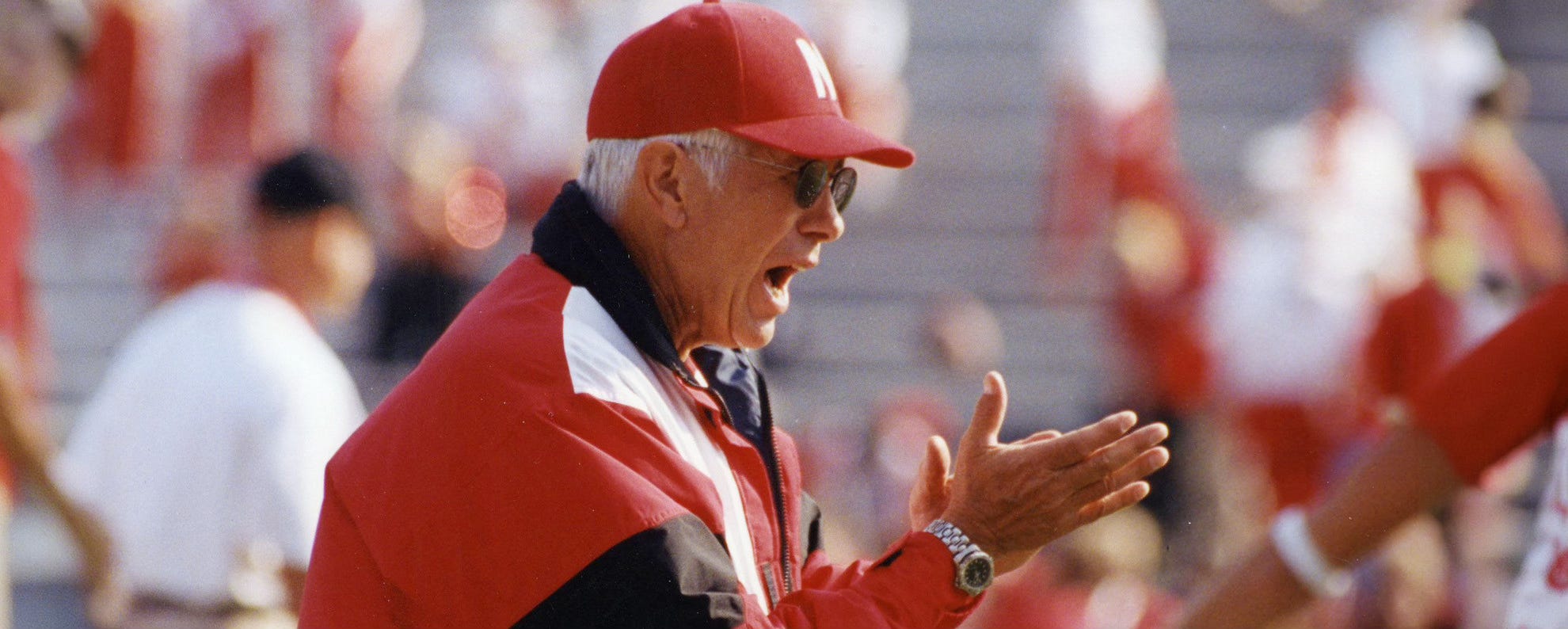
Three things I remember about 1996 Nebraska Football School:
One, turf burns. First day of camp, first time on artificial turf, I try to make a diving catch. I don’t come up with the ball, but both of my forearms come up completely shredded, which was fun to deal with over the remaining two days. The small-town grass at my high school field was nothing to write home about, but it didn’t do that. My takeaway was that the predominant playing surface of the era didn’t seem to be good for actually playing.
Two, I didn’t particularly want to be there. This is insane. With Nebraska coming off its second-straight national title, there probably wasn’t a better football camp in the country to attend that summer. All I had to do was say “yes” when my best friend asked if I wanted to go and then ride six hours with him in his parents’ van to Lincoln. Some of the best football instruction in the country was just that close. As Nebraskans, you could even argue it was “ours.” But I was a sophomore-to-be and at that point I liked playing football—the games, which felt like a big deal even in my very small slice of the world—way more than practicing football.
Three, Nebraska’s secondary coach George Darlington telling me to “hot step” it over and over again. As a moderately athletic, definitively skinny 15-year-old, I was a wide receiver/defensive back by default.1 This meant I split my time between Ron Brown2 and Darlington. The lone piece of football instruction I remember from that camp was Darlington’s description of how NU’s DBs were taught to go from a full-speed backpedal to forward acceleration. That was the hot step. Pretend the end zone is the surface of the sun, Darlington told us, pointing at the goal line in North Stadium, where we were about to be asked to put this in practice. You don’t want to plant your heel on the surface of the sun. That would hurt, but it also was the least efficient transfer of energy. Instead, you wanted a little two-step—real quick, short and choppy, balls of your feet only—to propel you forward. It was a three-day camp, but as I recall we worked on this technique for 13 years.
I wouldn’t encounter Darlington again until 16 years later. He had coffee and donuts waiting for me. I told him of my memories of the hot step. Then we started the tape.
I was at Hail Varsity in 2012, my first full-time position as a sportswriter, and we had an arrangement where every Monday morning, before the weekly press conference, Darlington would take a few of our staff through the coaches’ tape from the previous week’s game. This was in the basement of his home, coffee and donuts every time, which is a kindness I still find remarkable.
We got to experience that 2012 season through the eyes of an expert, through the eyes of a coach with degrees from Rutgers and Stanford who spent 30 years as an assistant at Nebraska and was a part of three national titles and more than 300 wins. We’d watch all the plays every week, but as journalists we were often most interested in the big plays everyone was still talking about on a Monday. If it was a gaffe, Darlington might tell you it was structurally sound and well-executed—“the other guy just made a play.”3 Sometimes when it was a success, you’d learn the play was close to a bust—“this guy’s just better than that guy.”4
These sessions weren’t so much an explanation for coachspeak as they were a guided tour of its source. There’s a reason all coaches have a shared vocabulary that leans heavily on things like “execute,” “make a play” and “on to the next.” There’s a different level of understanding to what happens on the field, both through hard-earned knowledge and a reluctant peace with randomness. The coaches know beforehand when they have little hope of blocking the opponent’s 320-pound tackle, and they know when the opponent has little hope of blocking theirs. Gameplans are built around those facts, and, if you game-planned well, it’s not a surprise when the games are decided by a fumble, improbable catch or a safety’s slip.
I didn’t know when I took my first sip of Darlington’s coffee that we was a teacher—literally, Football 101—but I would’ve guessed by Week 2. He had a gift for sharing knowledge. That concept he explained on a play from the first quarter? When it came up again in the third, he’d pause the tape and ask, “Now where is this linebacker supposed to be.” Get it right and he’d give a nod and a soft, “That’s good.”
Plenty of former Huskers drop by the press box for a game day at Memorial Stadium. Darlington was there every Saturday he could be. I made a habit of trying to touch base with him at halftime each week. He’d usually open with, “Well, what do you think?”
I never knew what to say, as if I had any insight to offer this man who’d spent a lifetime playing, coaching and teaching the game. But that’s what great teachers do. They increase your understanding while also valuing it, wherever it is.
George Darlington passed away Sunday, age 87.
He’ll live on in my mind and those of many others for as long as we’re around.
In a clichéd sense, maybe this fit my personality by default as well, given I didn’t love practice and, as I quickly learned, hated turf burns. I was not the cloth from which gridiron warriors were cut.
This was my hand-written scouting report from Brown in 1996: “Brandon, you tested very well for your age. You have good leg explosion. Work hard on the cone drills for your patterns and agility. Catch 300 balls per day and hit the weights and speed drills often.” Fair enough. I still can’t believe coaches on the staff that dismantled Florida five months earlier in the Fiesta Bowl were writing these for 300-some campers at each of, I think, three sessions that June. That’s 900 hand-written notes across the staff. What did we do to deserve that? It wasn’t that expensive, but I guess that’s easier to say when you didn’t pay for it.
Well, that’s not great for narrative.
Also not great for narrative. And that’s one of the key things Darlington helped show me. Narrative is just order from chaos. That’s fine. But the source material is still mostly chaos.
As Don Bryant said, you've got to be a "tough SOB" to get old. That's not just you and the aging process, but the sadness of the loss of those around you. I read this with a heavy heart. May George rest in peace . . . with the best seat for Husker home games (and away).