


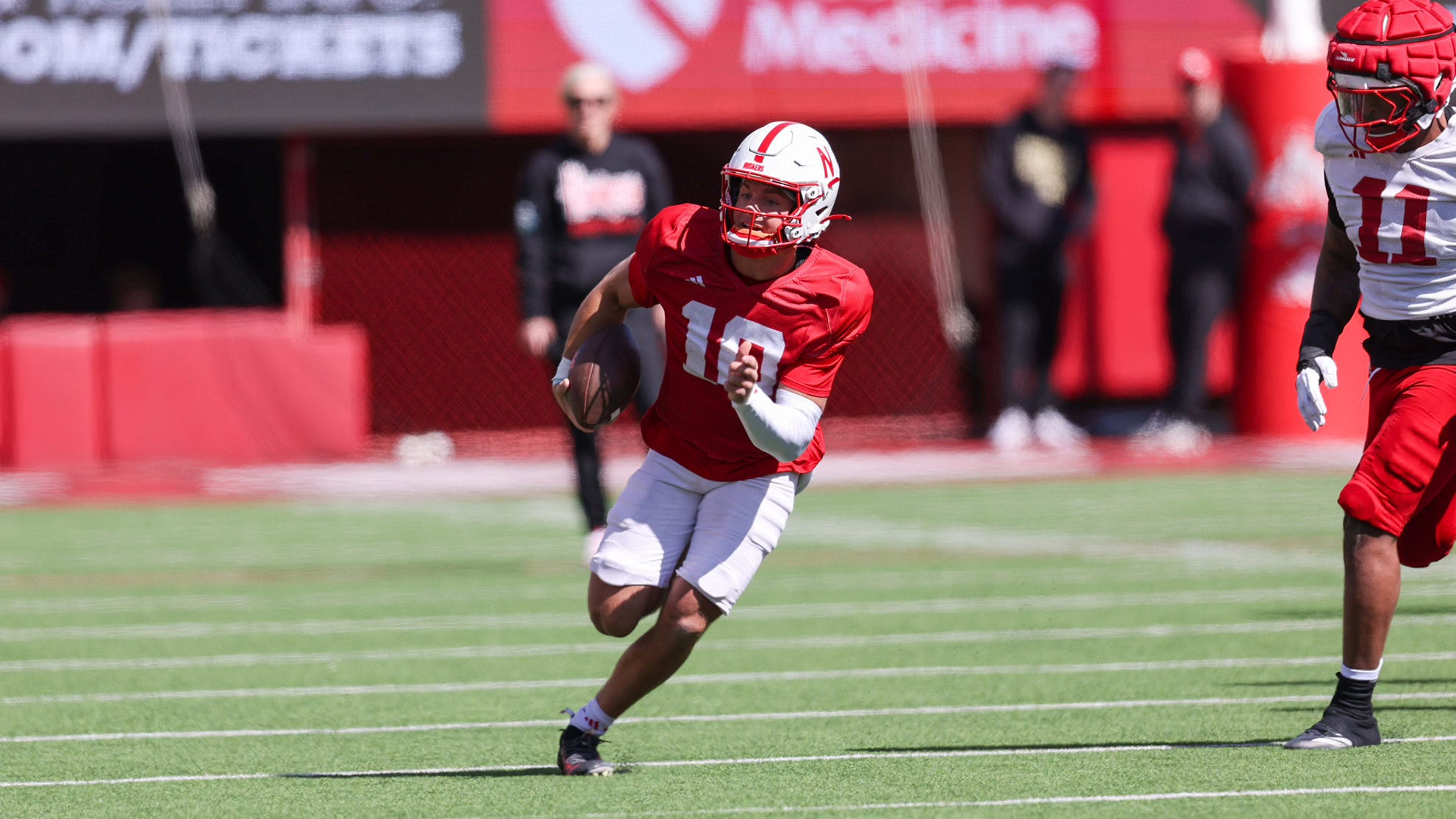
The Equation for Nebraska football in 2026 has yet to fully form in my mind, but it’s partially there. I mostly viewed Saturday’s spring game through that lens—show me something in the areas I’m already thinking will be important for the Huskers come fall.
These aren’t deeply held secrets, but part of the upside of taking the long view is that a mostly quiet spring, comparatively brisk (but entertaining) scrimmage or the “well, what can we really take from this?” nature of spring games is much of a hindrance.
So, here are three things I wanted to see1 Saturday compared against what I saw from the Red-White game.
Defense is NU’s biggest growth opportunity.
Tony White’s first defense at Nebraska ranked 9th in SP+ (13.92) in 2023 and took a small step back to 17th (15.8) in 2024. White left for Florida State and John Butler’s first and only NU defense dropped to 38th (22.7). It wasn’t the outright collapse it felt like by the end of the year, but it looked like one over the final three games.
In 2025, Rob Aurich took his first and only San Diego State defense from 41st the season prior (32.1) to 8th (19.6). He engineered that change without a major influx of talent from the portal and without being all that reliant on turnovers.
Nebraska’s 2026 probably hinges on a similar trajectory for the Blackshirts. I would be foolish to say “it’s gonna happen” based on the spring game. It seems foolish to mention many of the stats given the basic objectives from an actual game—move the ball, score, win—are all muddled here, but neither offense averaged more than 5.1 yards per play.
This was more of a vibe thing. Having watched the game twice, I thought Nebraska looked closer to the defense we saw in 2023–24—more hats to the ball, solid tackling, more confidence in what they were doing. Both defenses just looked more active, an uptick that comes with confidence which comes with clarity.
Show me Anthony’s intangibles
No surprise, but UNLV transfer Anthony Colandrea looked like the guy at quarterback.3 He was an efficient 12-for-19 passing for 80 yards with two touchdowns and an interception while working with the top offense. Minus the yardage, that’s not far off what might be reasonable to expect when the games count. Colandrea will probably be about a 65% passer. He’ll get his touchdowns and made some strong, decisive throws. The interception was on a cross-body throw into traffic that simply shouldn’t have been made.
Colandrea’s running ability was mostly kept under wraps, but you saw a flash in a 12-yard run that might’ve been much longer if the quarterbacks actually had to be tackled. That part of his game will be vital to his total impact in Lincoln.
Overall, I think Colandrea’s chill swashbuckler nature could be the thing Nebraska needs this season. Most of the Husker quarterbacks I’ve covered eventually showed the weight of the inherent attention and expectations in Lincoln. This is a place that cares about who the third-string guard is and still views winning as the natural order of things.
Maybe I’ll be wrong, but my early impressions are Colandrea might be quirky-but-talented enough to not take on the weight over 12 games. It might feel a bit like early-era Taylor Martinez, though the weight (and injuries) eventually showed for him, too.
But Nebraska doesn’t need Colandrea for four years, it just needs him now.
What’s the wildcard?
Colandrea might be Nebraska’s best bet for an individual change agent, but against this 2026 schedule the Huskers will probably need another. That or get something almost unforeseen from somewhere else.
You could argue that Nebraska’s “wildcard” in 2025 was a special teams unit that ranked among the best in the country. You could also make a strong case for Emmett Johnson producing a first-team All-Big Ten season. Neither was enough to push NU past 7-5 in the regular season, which should provide an idea of how high the bar can be in this category.
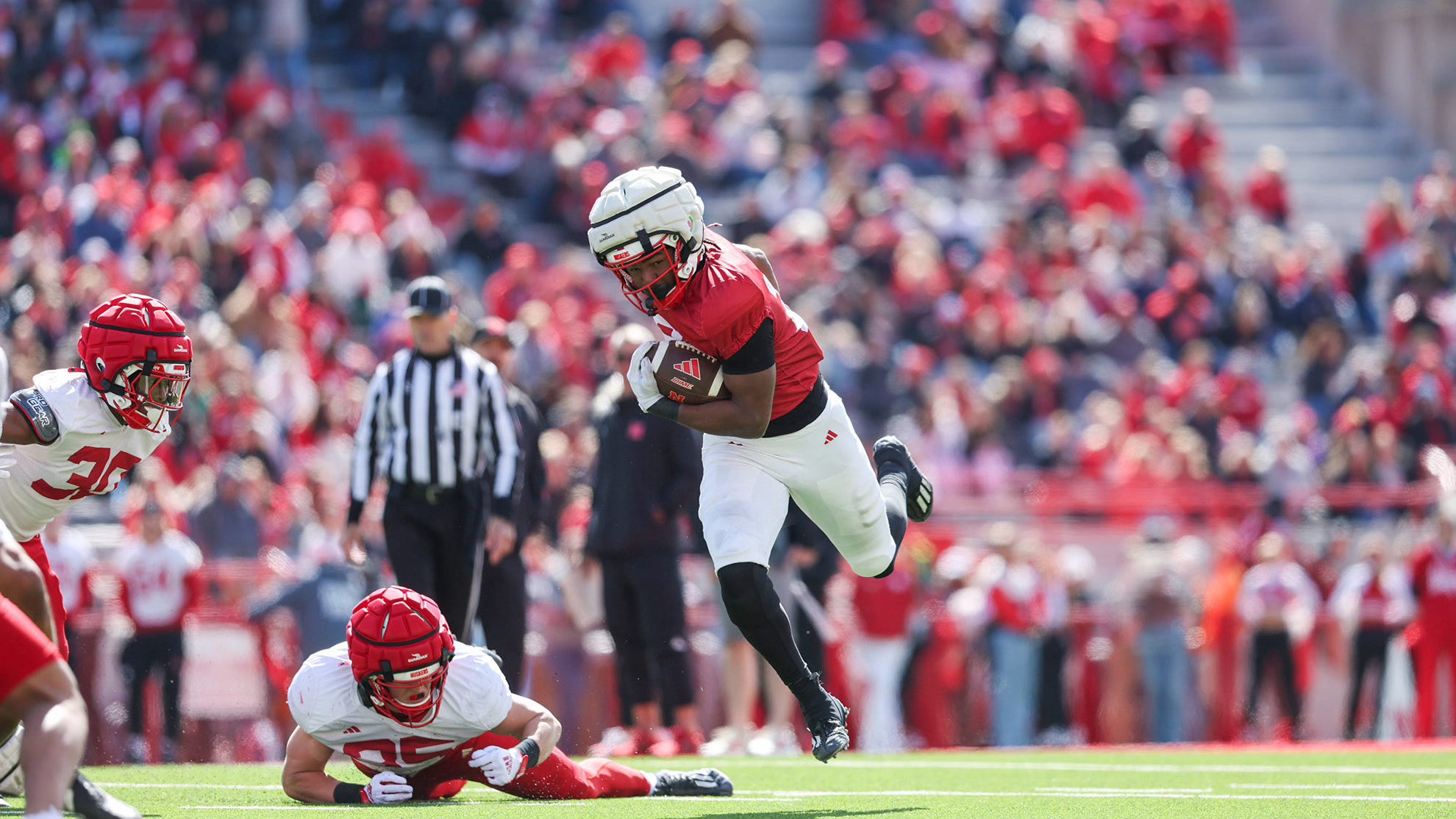
But I liked what I saw from two running backs in the game. Jamal Rule led all rushers with 119 yards on nine attempts, including a 75-yard gallop. Take out the long touchdown and the true freshman still averaged 5.5 yards per carry, looking like he’ll be a factor in the fall. Bound to get less attention, but arguably more important, Isaiah Mozee looked strong with 6.8 yards per carry on six rushes.
It might be somewhat foolhardy to go looking for something unforeseen in a spring game, but I wasn’t looking for anything in particular. It was more just “somebody show me something,” and Mozee and Rule were two that jumped out. If the pair even combined for the numbers Johnson put up last year, I’d still count it as a surprise, but it feels closer to possible than it did pre-scrimmage.

Big Picture
Last week ESPN’s Bill Connelly released his first SP+ rankings for 2026 with the Huskers coming in 37th (7.7), 10th-highest in the Big Ten. He also published detailed writeups on some of the components of those rankings. There was good news for NU; by Connelly’s method the Huskers are the second-most experienced team in the country. There was medium-good4 news as the Huskers were middle-of-the-pack when it came to “luck” in 2025.
But the real reason I’m always eagerly awaiting these rankings is they allow us to get a more detailed picture of the shape of the season ahead. We already know the Huskers’ schedule is daunting, and it really ramps up after the first five games. But by using the SP+ ratings to project point spreads for every game—using a blanket 2.5-point home-field advantage—we can compare that to historical results of outright wins since 2003 to estimate a win probability for every game. Sum those probabilities and you’ve got a projected win total.
Do all of that for Nebraska in 2026 and it looks like this:
How accurate has this method5 been? In 2024 the February SP+ ratings produced a projected win total of 7.3 and the actual point spreads at the times of the games—which factor in performance, injuries, weather, etc.—would’ve projected 7.1 (-2.7%). Nebraska went 6-6 in the regular season.
In 2025 the first SP+ ratings pointed to 7.5 wins in February and the actual lines produced 7.4 (-1.3%). The Huskers went 7-5 in the regular season.
Not bad for ratings produced five or six months in advance of any actual games, and this method is always pretty close to the win totals that come from the oddsmakers. A few weeks ago, FanDuel released an opening win total of 5.5 for NU, and it was quickly bet up to 6.5, which is closer to where SP+ might have it.
There will be outliers to what you see in the chart above. Prior to the 2024 season—before a lot of people knew much at all about Curt Cignetti—the early SP+ number for Nebraska-Indiana was around NU -11.5. The game went off at IU -6.5. Last year’s Michigan game looked like Wolverines -7 in the preseason but went off at Huskers -1.6 Things do change.
Just not as often as people think. There are examples of games looking nothing like we thought they would in the offseason. But even with those individual exceptions, the win totals still end up being about right by a two-thirds majority. Last year, half the Big Ten finished within a half game of the oddsmakers’ preseason win totals and another six teams were within 1.5 regular-season wins.
Point is, even after a spring game I would describe as mostly positive, there is solid evidence through all these numbers to believe Nebraska is most likely a six-win team in 2026.
The Equation, when it fully renders in the weeks ahead, will try to show a path to exceeding that. Spoiler alert: It’s probably going to take something significant from the Huskers.
This will give you a decent idea of where The Equation is headed.
Read that rating as Nebraska’s defense was expected to allow 13.9 points against an average FBS offense. That 2023 defense allowed 18.3 points per game in the real world, playing a nine-game Big Ten schedule.
Which is basically what we heard all spring.
The best news in the luck department is your team had whatever record it had while being a victim of randomness (i.e. better than the record). The worst news, at least from a predictive view, is being extremely fortunate (i.e. worse than the record). Nebraska was 7-6 with pretty normal turnover and one-score-game numbers, so it’ll have to improve in 2026 mostly on its own, which is better than waiting around for things to even out.
And I am evaluating more what I choose to do with the SP+ number than the numbers themselves.
Fun fact: -1 at home is a bad spot to be. Teams in that spot have won outright just 46.4% of the time since 2003. At -2 its 54.3% and at -3 its 55.2%.