


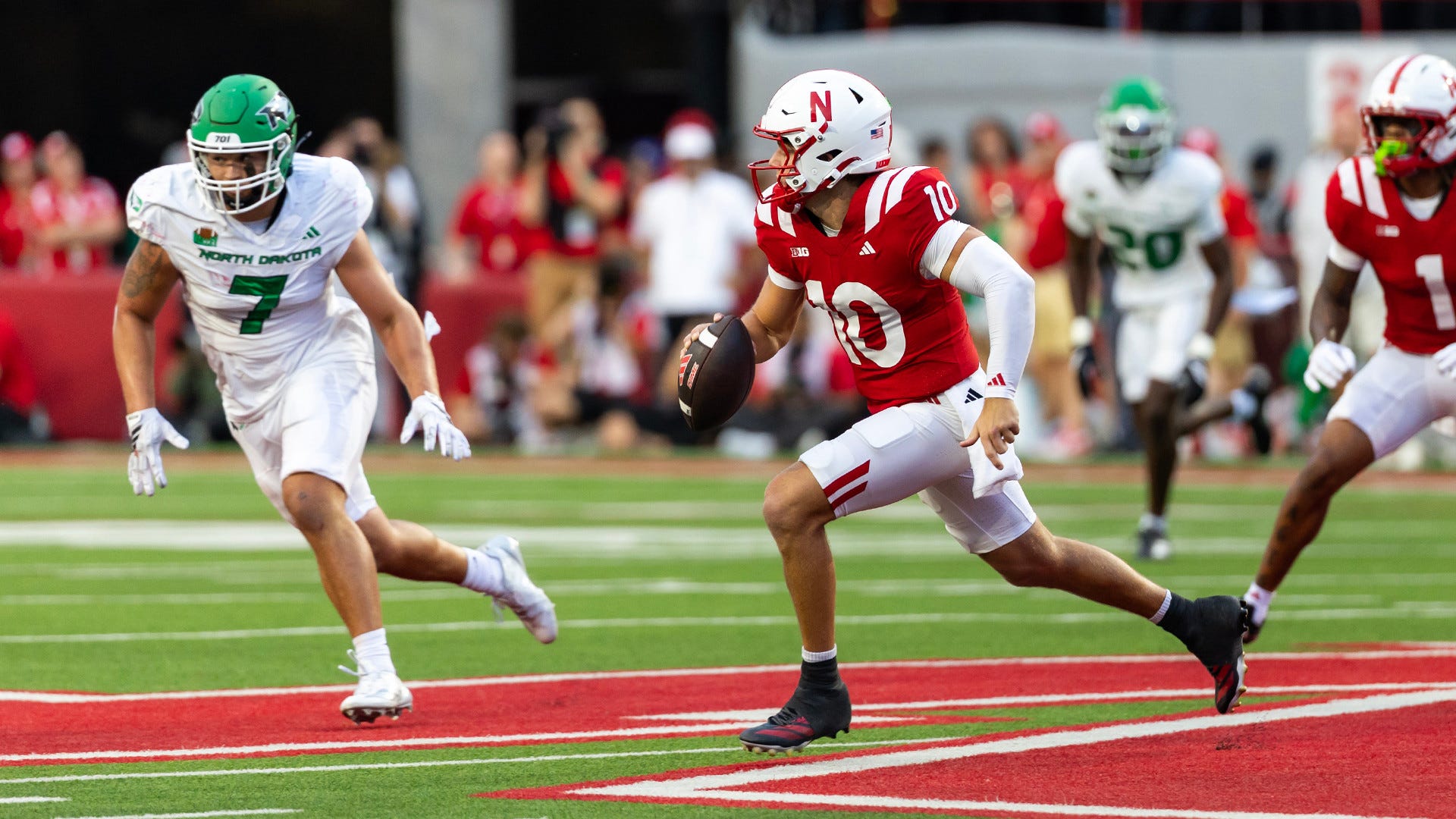
Nebraska is 3-0. It would’ve been a disaster if the Huskers didn’t get there against a slate that included three home games where NU was favored by at least three touchdowns each time out. The start wasn’t a disaster. We can safely say that.
Your mileage may vary on anything stronger than that, but I think Nebraska’s three blowouts went as well as was reasonable to expect. Maybe even a little bit better.
Theoretically, total dominance would look like a team winning every play by success rate thresholds—a 100% success rate. Practically, it’s impossible. Indiana, 3-0 and having outscored three featherweights 145-16, leads the country in combined success rate right now at 65.8%. Georgia’s next at 65.0%.
Nebraska produced a 58.4% rate over its first three games, 16th nationally and 12th among power-conference teams. Pretty good, right?
Well, it’s complicated. After scraping out a win over Cincinnati and pummeling Akron and Houston Christian in the first three games last year, NU’s combined success rate was 59.9%, 12th nationally and 11th among power teams. A lot of the Huskers’ numbers look good so far in 2026, but they were in a similar spot a year ago and nobody needs to be reminded how things finished.
So, there’s some fuel for the people who prefer to remain in the “prove it” category after a 3-0 start that was entirely expected. I would still maintain Nebraska performed at least as well as could’ve been projected, and there’s a reason I used success rate to start. No matter the level of opponent, all a team can do is try to win more plays than the opponent. They’re the building blocks of a game, and if a team wins more than the one on the other sideline, it typically wins on the scoreboard, too.
Nebraska has won plays at a top 25 level so far. Hopefully that provides some context around what we’ve seen to this point, even if it doesn’t tell us how steep the dropoff might be as conference play begins.
For additional context, we turn to something that does try to control for quality of opponent—Bill Connelly’s SP+ ratings for ESPN. Here’s the change in every Big Ten team’s rating from preseason to now in SP+, which is opponent adjusted.
After three full weeks, Nebraska is the biggest mover, positive or negative, in the Big Ten.1 The Huskers’ rating has improved 5.2 points, and its ranking has climbed from 33rd in the preseason to 23rd. That’s pushed NU ahead of Washington and Illinois, opponents Nebraska faces in back-to-back weeks bridging October and November.
Pretty good, right?
Well, this also happened last year, too. Here’s the same chart for the same point in the 2025 season.
After three wins last year, Nebraska had improved its SP+ rating by 5.7 points. One key difference, however. Last season the Huskers’ gain—bigger than this year’s, which is the biggest in the conference so far—was only the sixth-best jump in the Big Ten.
Look at the two charts again. Nebraska improved its SP+ rating with three wins to open the 2025 season, but so did six of the eight teams that started the year ahead of NU. There were nine teams ahead of the Huskers in preseason SP+ this year, and only four of them saw a ratings improvement entering Week 4. Ohio State and Oregon are going to be fine, but both backslide after Week 2 losses on the road at original Big 12 teams.2 Indiana, playing a very similar nonconference slate to Nebraska based on various strength of schedule ratings, hasn’t seen its rating change at all while going 3-0. Michigan slipped a bit, even with a home win over Oklahoma.3 Washington, an unimpressive 3-0, has seen its rating slip more than any Big Ten team not named Rutgers.
This might be something that impacts what’s to come. Maybe the numbers don’t show a Nebraska team that’s done anything different than what last year’s team did. Maybe the numbers also show a greater change in the context around NU. Namely, the Big Ten might be more wide open than it was at the same point a year ago, when most of the favorites were lengthening their leads over the rest of the field.
In Connelly’s résumé SP+ ratings4 this week, which compare actual scoring margins to what a top five team would be expected to produce, Nebraska ranked 12th nationally. Against Ohio, Bowling Green and North Dakota, the Huskers’ actual scoring margin was only 2.5 points off what an Ohio State, Georgia, Notre Dame, Indiana or Oregon might’ve been expected to produce.

Connelly also uses the completion of Week 3—college football’s quarter pole—to rank all of the remaining undefeated teams. Last year’s Huskers came in at No. 23. This year’s team debuts at No. 18.
So, there’s some evidence for the people who prefer to occupy the “it’s happening” category after a 3-0 start that was entirely expected. I’ve liked most of what I’ve seen from the Huskers so far. I’ve liked it slightly more than what I’d seen at this same point last year. But there are still no obvious answers to the question of “is this real?” based on what we’ve seen so far.
I’ll never write anything better than John Prine already wrote it, so play us out, John:
Pretty good, not bad, I can’t complain.
But, actually, everything is just about the same.
Yes, this means Nebraska has improved more than Rutgers has regressed during a 0-3 start with losses to UMass, Boston College and USC.
Texas and Oklahoma State, respectively.
The Sooners beat New Mexico 14-6 in Norman on Saturday. New Mexico is good, but still.
“Résumé SP+ compares each team’s scoring margin (capped at 50 points for a given game) to what an average top five team would be expected to generate against a given opponent.”