


Georgia, Miami, Indiana, BYU, Utah, Nebraska. What do these teams have in common through four weeks of the 2026 season?
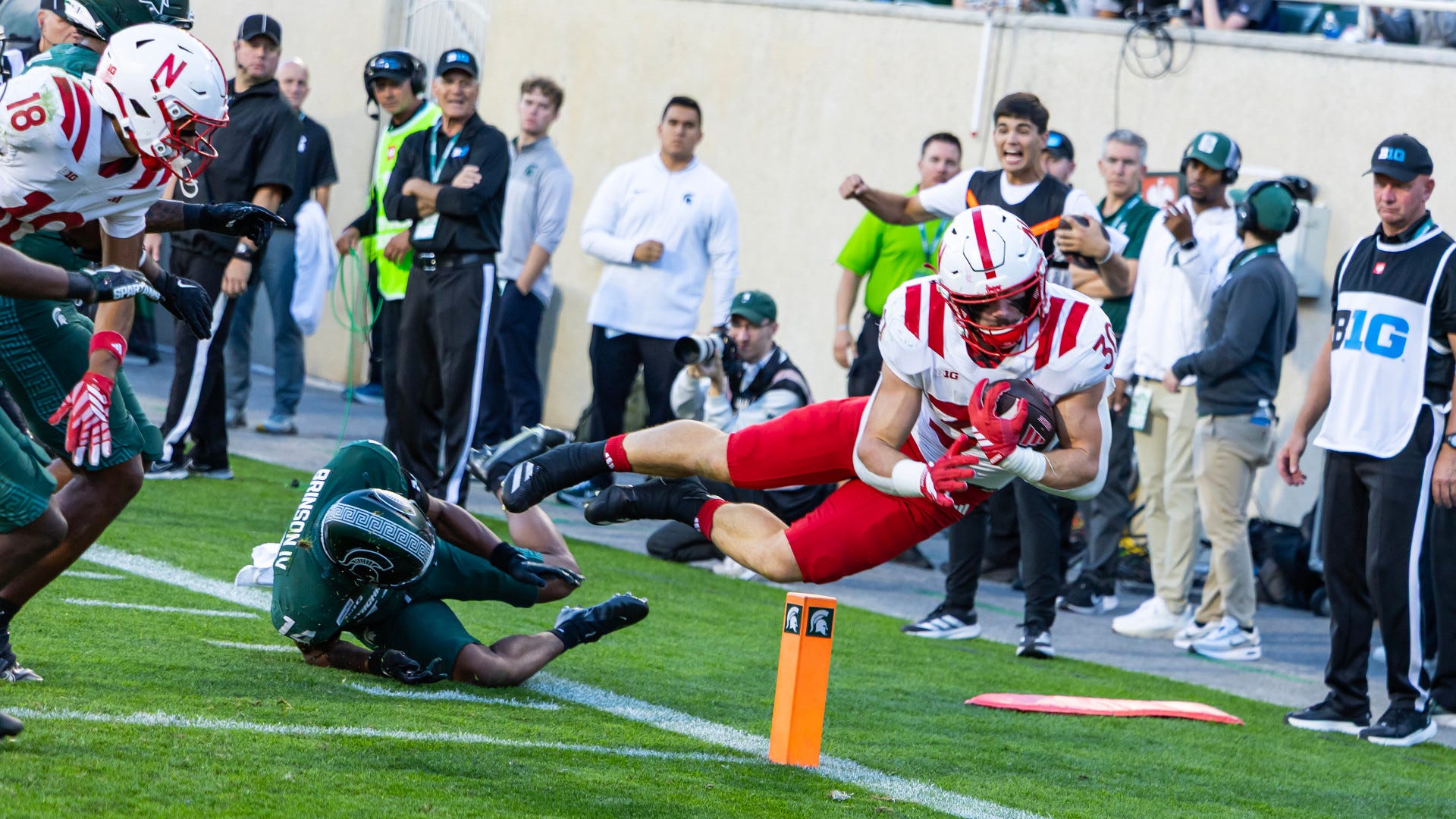
Not a ranking in the AP poll. Sunday’s release had the Bulldogs at No. 2, Hurricanes at No. 4, Hoosiers at No. 6, Cougars at No. 10 and Utes at No. 13. The Huskers remained unranked following their 31-13 win at Michigan State to move to 4-0. Nebraska was effectively 33rd, receiving 36 votes this week.
That’s fine. The AP poll at this point in the season is a messy-but-beloved1 combo of preseason perception and varying poll logic.
Besides, what Nebraska does have in common with those five top 13 teams is better than a Week 4 ranking.
Here it is: Georgia, Miami, Indiana, BYU, Utah and Nebraska are the six teams averaging at least 0.4 Expected Points Added (EPA) per play on offense and allowing fewer than 0.0 on defense.
Bear with me, this must get jargony for a second, then it will get interesting. EPA is meant to be the closest thing we have to an all-in-one measurement in a sport where no one thing ever really describes exactly what happened. This is what makes football the right blend of fun and frustrating. Using historical data, EPA is basically assigning a point value to every play as it measures how much any play increases or decreases the offense’s expectation to score. Big numbers are good for the offense, low numbers for the defense.
The thresholds mentioned above are arbitrary, or at least they started out that way. I was playing around at collegefootballdatabase.com, as I usually am on a Sunday, and happened upon this chart:
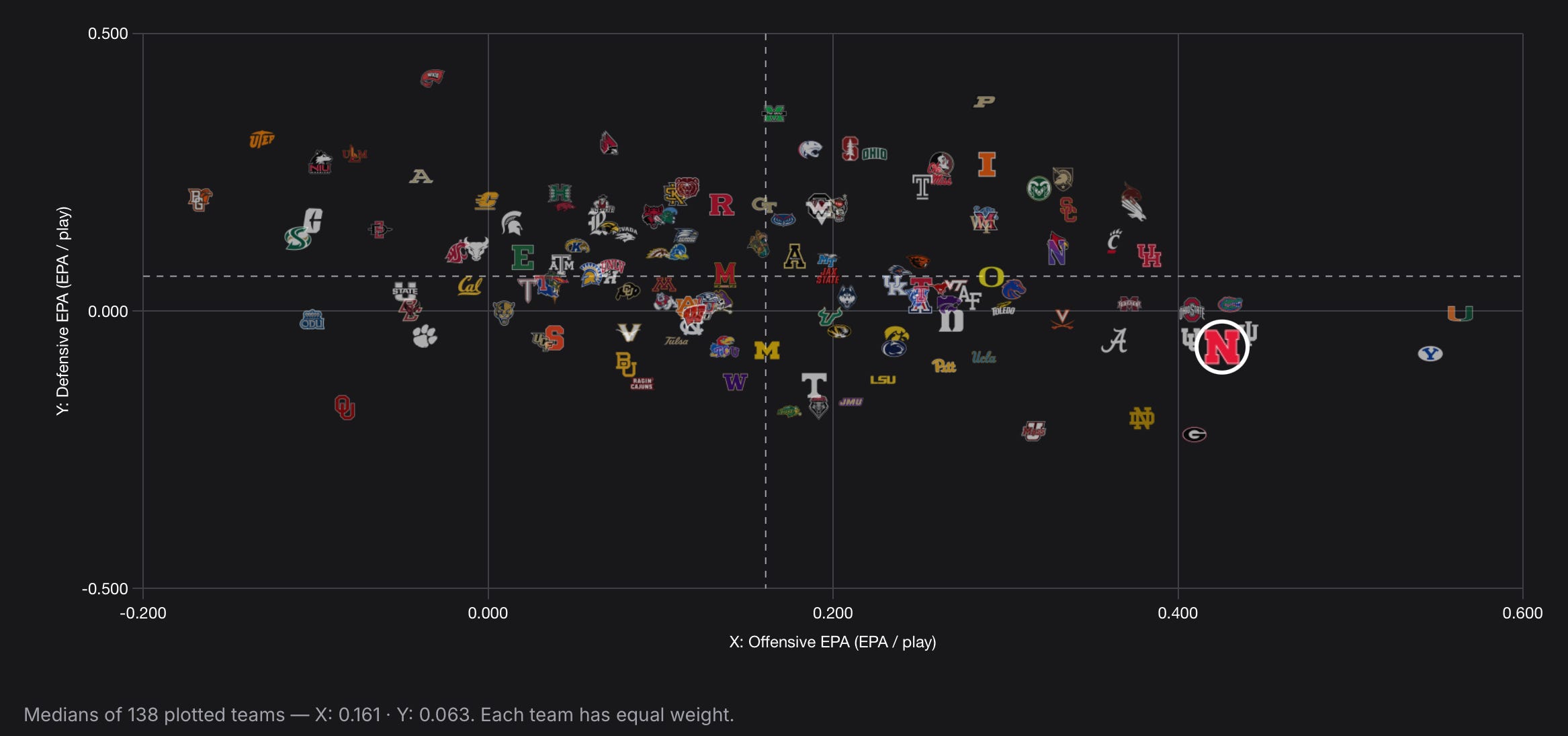
That’s a pretty good group of teams to live around, I thought. In addition to those mentioned, No. 5 Ohio State and No. 8 Florida are knocking on the door of the >0.4/<0.0 club after Week 4. But does it mean anything after four games with varying levels of competition faced, even in this exclusive neighborhood?
To the start of the 12-team playoff era we go.
2024: Six teams were in the club after Week 4. Three of those—Ohio State, Texas, Indiana—made the Playoff. The three that didn’t were Alabama (9-3 regular season) Miami (10-2) and Mississippi (9-3), the first three teams out in the final CFP poll. Combined, this group of six went 62-12 (.838) in the regular season.
2025: Six teams again, but there’s a complication—somebody let Florida State in the club after four weeks and the Seminoles finished 5-7. Of the remaining five teams, two made the playoff, Oregon and Indiana. Two more were G5 teams, Old Dominion2 (9-3 regular season) and Navy (10-2), and both had great seasons. Washington was the last team, finishing 8-4, which, with a bowl win, was enough for the Huskies to start 2026 17th in the AP poll. This group of six combined to go 55-17 (.764) in the regular season.
So, the 2025 club wasn’t as exclusive as the previous season, but if you combine them, you get a regular season record of 117-27 (.801), five playoff appearances from 12 possible teams (.417) and only one season with fewer than eight regular season wins. Nebraska would take any of the win totals mentioned in 2024 and 2025, minus Florida State’s collapse last season.
Point is, grab a pair of dice. Roll them. If the total is less than seven, Nebraska’s going to the playoff this year based on the past two seasons.
OK, I don’t actually believe that yet. The Huskers win over Michigan State basically came down to winning toxic differential—explosive plays plus turnovers—which is indeed often toxic to opponents but is volatile.

But the best news about EPA differential (offense minus defense) is that it was fairly sticky over a small sample size. Removing garbage time but without controlling for strength of schedule, the six teams in the >0.4/<0.0 club after four weeks in 2024 finished the season ranked no worse than 15th in EPA differential at the end of the year with an average change of ranking of -2.2 spots. In 2025, no team ranked lower than 40th at the end of the year (thanks, Florida State) with an average change of -9 spots.3
If Nebraska, currently sixth in EPA differential, fell to, say, 15th by the end of the year that was Alabama (9-3) in 2024 and James Madison4 (11-1) in 2025.
Nebraska is in the club after four games. It wasn’t in 2024 or 2025. Do with that what you will. Football remains fun and frustrating in equal measure over a long enough span.
A conference as wide open as its footprint?
Maybe you buy the promise Nebraska has shown so far. Maybe you’re still skeptical. Either way, we need to talk about the Big Ten because wherever the Huskers fall in it, the conference might be as jumbled as we’ve seen it in recent seasons.
This past week: UCLA went across the country and humiliated Maryland when the Bruins are used to just getting done with breakfast. Minnesota went to Washington and won after its usual bedtime. Iowa won at Michigan despite having a 14% win probability with 2 seconds left. Wisconsin won at Penn State despite having a 12% win probability with 73 seconds left. Conference favorites Ohio State and Oregon already have losses.5 Indiana looked as wobbly as it has in two years in a Friday night win over Northwestern.6
The Big Ten of the past few years has been a horse race with three or four prohibitive favorites. Maybe it will still be that, but right now it looks more like a demolition derby.
That’s good news whether you’re all-in on NU after a 4-0 start or still in wait-and-see mode. The Huskers are among the most (positively) surprising teams in the league so far, outperforming the line by an average of 8.6 points per game. Only UCLA (18.0) and Northwestern (15.7) have been better.
This has the makings of a good year to be better than expected because others (Washington, USC, Rutgers) have been busy being worse.
By me at least. I hope the AP poll lives forever.
ODU, you may recall, lost 27-14 to Indiana in last season’s opening weekend. Alabama would lose 38-3 to the Hoosiers in the playoff four months later.
Both numbers are negative here because >0.4/<0.0 isn’t really sustainable over a full season, so we use rankings to look at how the numbers fall in relation to every other team.
The Dukes made the playoff out of the freakin’ Sun Belt. Then their coach, Bob Chesney left for UCLA, and he has the Bruins ranked thanks to four dominant wins to start this season.
Though both were on the road to currently ranked teams.
The takeaway here might be the Wildcats are just good.