


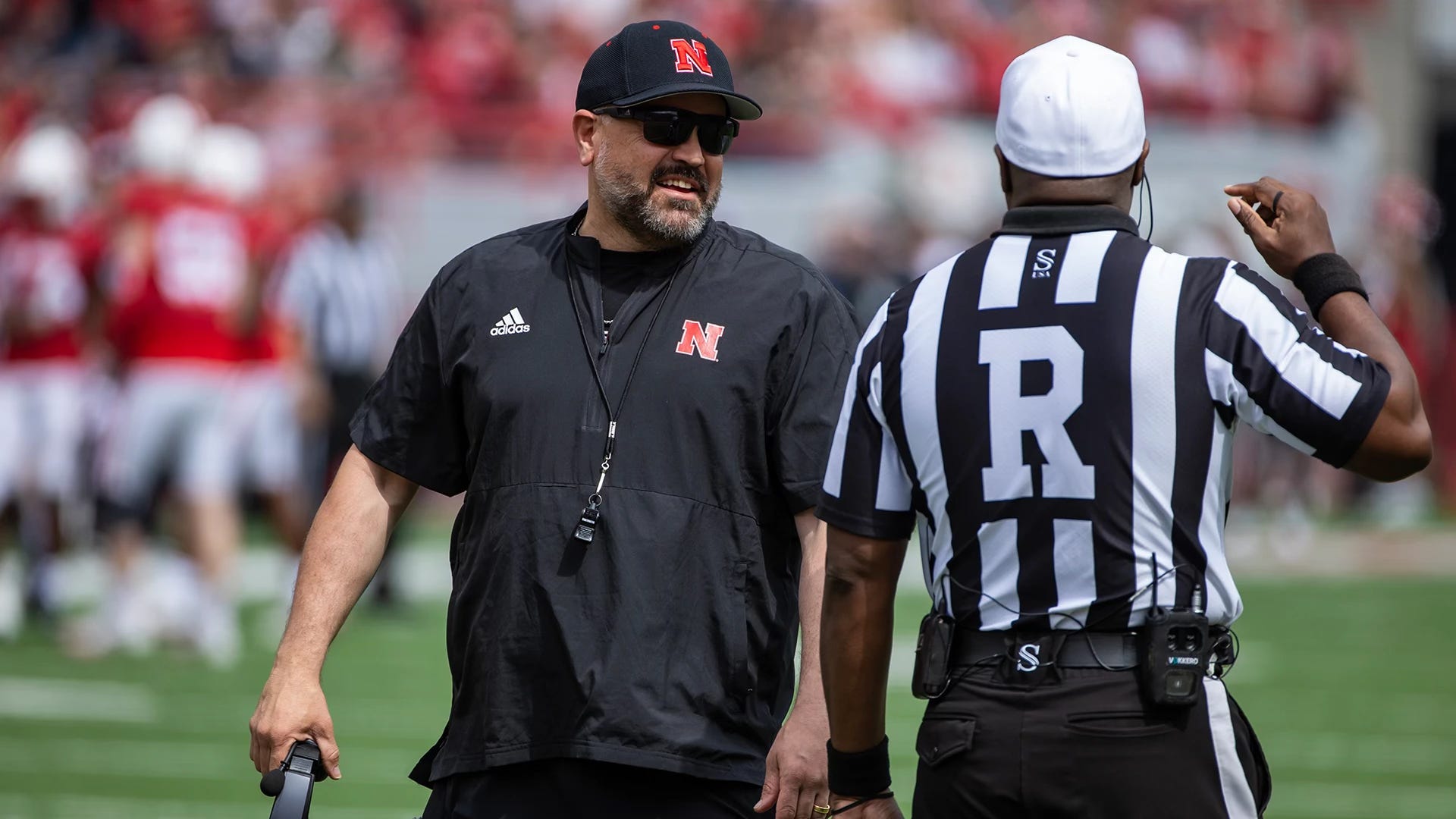
Nebraska held a press conference Thursday to kick off spring football practices, which felt fitting considering it had been in the 60s and 70s all week. Until it wasn’t.
It snowed—a lot—Thursday evening.
Still, spring football is here and Thursday marked Nebraska’s first formal availability since the Las Vegas Bowl.
There’s a lot from Thursday we’ll unpack in the coming weeks. For now, here are five takeaways as spring officially begins.
Matt Rhule mapped out the injury list
More than a dozen players will sit out spring practice. That includes receivers Demitrius Bell and Janiran Bonner, defensive backs Rex Guthrie and Blye Hill, offensive linemen Gunnar Gottula, Nolan Fennessy, Gibson Pyle and Julian Marks, defensive end Mac Markway, tight end Carter Nelson, linebackers Dawson Merritt and Gage Stenger, and punter Kamdyn Koch.
Four more—Conor Connealy, Tyson Terry, Trent Uhlir and Jake Peters—are waiting on medical clearance.
Guthrie, who had shoulder surgery, led all returning players in tackles last season. Gottula and Nelson would’ve been central to position battles. Bonner’s loss lingers into another offseason.
“He’s a big, thick guy,” offensive coordinator Dana Holgorsen said about Bonner. “When he went down in the first game I was completely devastated because it changed what we did offensively.”
This spring will be about installing new systems and defining roles for the Huskers, and that will remain the same (even if a handful of contributors are helping from the sidelines).
Nebraska returns practices to afternoons
We suspected it earlier this week. Matt Rhule confirmed it yesterday: Nebraska is moving practices to the afternoon.
“We’re chasing sleep,” Rhule said.
In a Big Ten that now stretches coast to coast, recovery margins matter. Nebraska played two East Coast games last year and then turned around in short weeks. This upcoming schedule includes just one bye week.
Rhule admitted part of the staff prefers mornings. Former head coach Scott Frost moved practices to the morning in 2018 and that model stuck for seven seasons, but the logic has shifted.
“I don’t care what time they have to wake up, they’re going to bed at the same time,” Holgorsen said. “So it’s going to give you a little bit more recovery. It’s going to give coaches a little bit more prep time prior to practice.”
Cornerback Andrew Marshall wasn’t upset about the chage.
“I love a little extra sleep,” Marshall said. “So that’s definitely a benefit.”
The shift will continue into the fall as well. Rhule indicated Nebraska will likely operate in that traditional 2:30-6:30 p.m. window during the season.
The quarterback room has a different tone
Nebraska held a walk-through Thursday, which ended in sprints. The player near the front? Anthony Colandrea.
“He competed as hard as anybody just running the sprints,” Holgorsen said. “He’s a ball player.”
Rhule framed the quarterback group as deep. TJ Lateef and Colandrea both started games last year, and Daniel Kaelin returns with experience. That’s a different situation than last fall, when Nebraska nearly had to turn to its No. 3 quarterback against Iowa due to injuries.
Colandrea, though, is the focal point.
“He’s a dynamic player with a great personality,” Rhule said. “Very affable. At the end of the day, I think you want your quarterback to probably walk a little bit different than everybody else because he has a lot on his shoulders but be one of the guys. I think Anthony’s done that really, really well.”
Holgorsen wants to call plays “fearlessly.” Colandrea’s mobility helps that vision.
“There’s a balance to it,” Holgorsen said. “But having the ability to be able to make things happen off schedule is very refreshing.”
Center Justin Evans is still building chemistry with the new QB, but he thinks highly of Colandrea so far.
“I think he’s a great guy. I think he’s a great player,” Evans said. “He’s come in with great energy, high energy. We’re still getting to know each other but it’s all been so far so good.”
Holgorsen summed up the room succinctly.
“That’s a confident room right now,” Holgorsen said. “It’s a completely different room but it’s a confident room too. It all starts with Anthony. We brought him here for a reason.”
Rob Aurich is inheriting expectation
Nebraska’s defensive finish last season was, well, not awesome. Opponents scored more points as the season went on, the Huskers’ efficiency plummeted and the defensive front struggled to control games.
Enter Rob Aurich, who came to Nebraska from San Diego State.
“Being at smaller schools you get to see the development process of not necessarily having a roster you handpicked or you drafted, where you got the five-star, four-star,” Aurich said in his first Husker press conference Thursday. “So you tried to find unique ways for players with redeeming traits to help your team.
“And I think we’re a little bit of that situation here. We have a bunch of talented players. How do we get them to impact the team?”
Aurich brings a 4-2-5 system to Nebraska. It’s a system that is also rooted in Nick Saban principles and layered with modern NFL concepts. All of that is great, but there was one thing that really sold Rhule on Aurich.
“The thing about Rob is there’s no doubt he knows exactly what he wants,” Rhule said. “There’s no gray area.”
As for the interview, you could call it unconventional. Or, as Aurich put it, “unorthodox.” In what way? Well, it included watching Rhule’s daughters play youth basketball.
Now that he has the job, the defensive front is priority No. 1.
“There’s a way to play defensive line,” Rhule said. “Come off the ball, reset the line of scrimmage, dominate offensive linemen with their hands…stop the run and affect the quarterback. We’ve got talented players. The onus now comes on the coaches, wherever they are, to maximize them, develop them and make them better.”
Aurich talks about a “tunnel of execution.”
“Football is football,” Aurich said. “We believe in our process, we believe in what really good defenses look like from the way we execute and we’re going to try to live and drive our team to that standard.”
And he understands the weight of the job.
“I think it’s one of the best traditions in football,” said Aurich. “But you come here and the level of tradition with the Blackshirts and what it means and that pride of ownership—and earning that—man, I think that’s the most humbling part of the job.
“You feel a commitment, a gratitude, an ownership. This has to look a certain way.”
Pat Stewart’s portal blueprint is clear
Not everything we learned this week came from Thursday’s podium.
Nebraska general manager Pat Stewart joined Sports Nightly on Wednesday, laying out how the Huskers approached the January portal cycle. It brought in 16 transfers and, just as importantly, retained key contributors.
Stewart described the model in familiar terms.
“One thing we want to look at first is where our needs were,” Stewart said. “My background is in the NFL and you draft and develop players and you fill needs through free agency if you have some gaps. First you address the needs and then if something comes available where you can get a difference-maker you go out and do that.”
That philosophy showed up quickly when Nebraska had to pivot at quarterback. After Notre Dame transfer Kenny Minchey delayed signing, the Huskers moved fast to secure Colandrea.
“It happened pretty fast,” Stewart said. “Everybody knows the story and in talking to other people, that situation wasn’t unique to us where you had a player in the fold and then he wasn’t. At the end of the day, we get the contracts out as fast as we can and then it’s up to them to sign. A couple days came and the contract wasn’t signed and then you knew you’d have to pivot, that ended up happening and we moved fast. We were really lucky to get Anthony in as soon as we could.”
Colandrea wasn’t just a fallback plan for the Huskers though. He was ultimately a schematic fit.
“The skillset opens up a lot of things and makes defenses have to prepare and hold them accountable that he’s a dual threat guy who can do different things when he has the ball in his hands,” Stewart said.
Beyond quarterback, offensive line depth was a priority, especially in a conference like the Big Ten that punishes thin fronts.
“That’s one thing we really wanted to enhance was the depth. Whether you were going to add guys who were going to be in the pipeline for the future, or guys who had starting experience, it was something we really prioritized. We wanted to find guys who were big, strong physical guys who we could rely on when it was third and one,” Stewart said. “Those were guys we targeted early on and moved quickly on.”
Retention mattered just as much as acquisition, particularly with a new defensive coordinator installing a new system.
“When the portal happens, guys are looking at what their role was last year and not what it will be in the future. It’s laying that out to them and letting them know that they don’t have to leave to get that chance…a lot of our guys realize what we have going here and you don’t need to go chase your fortune somewhere else when you can build it here,” Stewart said.
The portal is chaotic and Stewart didn’t sugarcoat that fact.
“It’s just different. It’s faster pace. There’s a lot of gray. In the NFL you have an established market of where guys fall and where they’re going to get paid. In college you’re told things from different places and you can’t always verify. It’s not harder, it’s just a different process than what goes on in the NFL,” he said.
The takeaway? Nebraska is trying not to panic in the portal. It’s meant to be a place to construct a roster, or at least in the way Stewart frames it.
And this spring will be the first real test of whether that approach holds up on the field.
"It snowed—a lot—Thursday evening."
"Nebraska’s defensive finish last season was, well, not awesome."
Whoa, so much hyperbole in the Friday Five today!