


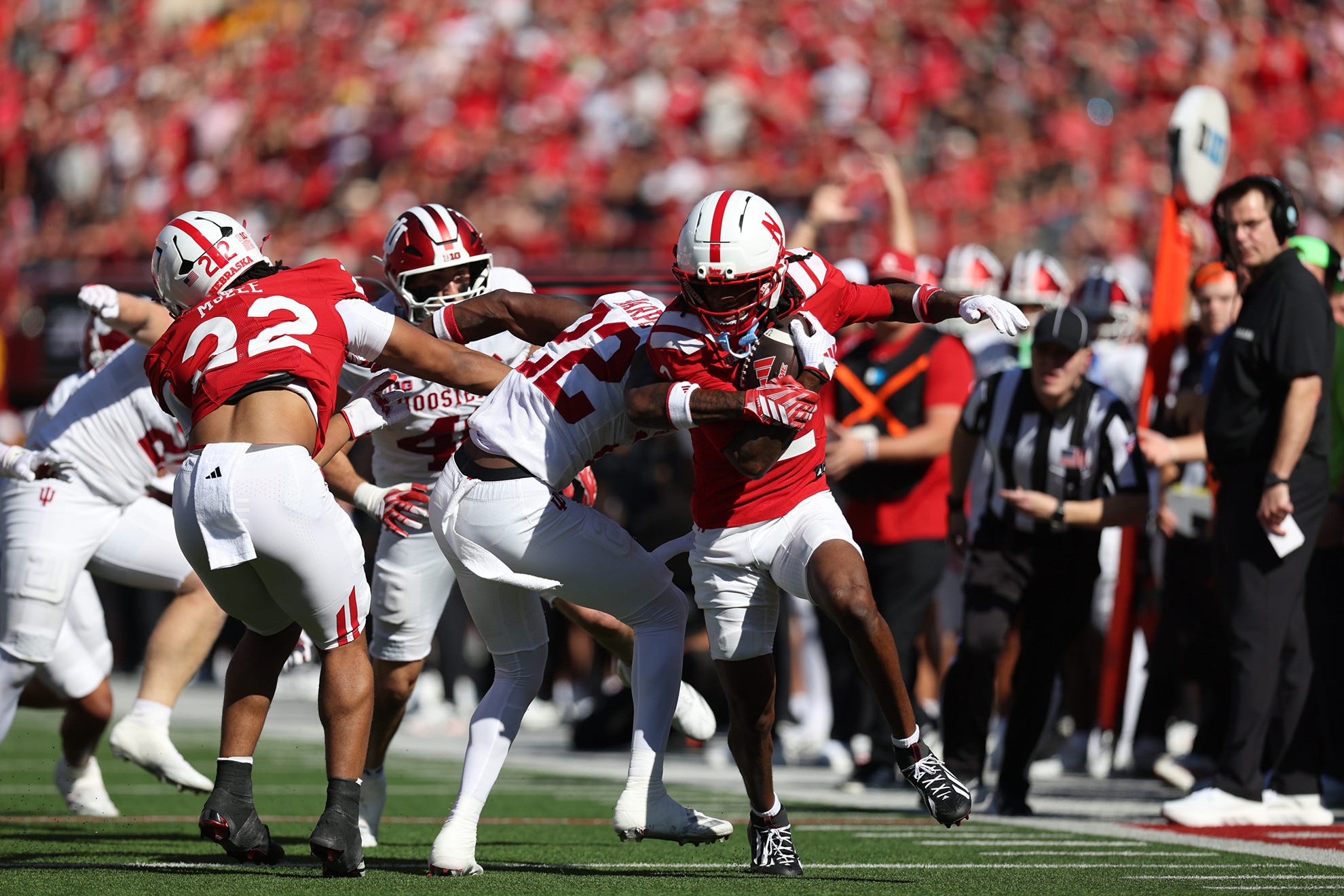
“Your guys clearly came to play. What is the message to keep this going in the second half?” Fox sideline reporter Jenny Taft asked Matt Rhule at halftime of Saturday’s Nebraska-Indiana game.
“Honestly, I don’t even think we came to play. This is what we do every week.”
It was easy to believe Rhule at that moment. The Huskers had controlled the clock, stopped the Hoosiers’ powerful run game and led 10-3. It should’ve been 13-3 if not for a missed 40-yard field goal. It could’ve been 21-3 if the Huskers had been perfect in the red zone.
These 45-second halftime interviews are usually boilerplate, but Rhule said something profound here. To rephrase it in my own words it was: We aren’t playing up to Indiana’s level, we are at Indiana’s level. It’s what, I think, he’s trying to get this team to believe. It’s what this program so desperately needs, but a win is the only undeniable proof.
Belief and proof remain different things. No. 7 Indiana came back to win, 20-17, the Hoosiers’ 22nd straight victory since the start of 2025.
“That wasn’t an Indiana team sleepwalking through this, and that’s not a Nebraska team that isn’t in their class,” Rhule said after the loss, an echo from halftime that offered more clarity.
This was a complex game, one that offered some of the best signs for the program in years and offered some serious concerns. So, you choose which way you want to go. There are two viewpoints slightly at odds below. Choose the one you prefer. Or read them both.
I choose belief
Nebraska’s defense held Indiana to 65 rushing yards, the fewest during the Hoosiers’ winning streak and the third fewest of the Curt Cignetti era. Indiana came in averaging 6.4 yards per carry (4th nationally) and managed 3.0 against the Blackshirts. This was, probably, the biggest ask of Nebraska entering the game and NU answered it emphatically.
The tradeoff was the Huskers betting their secondary could win enough solo battles against two of the best receivers in the country, and it was maybe one or two plays away from working. Indiana is Indiana right now because it makes those one or two plays.
On offense, Nebraska’s plan indicated it knew it wasn’t just going to hand the ball off and win, even with the return of running back Jamal Rule. So, offensive coordinator Dana Holgorsen was creative and aggressive. The Huskers threw the ball early. They got the wide receivers and quarterback Anthony Colandrea involved in the run game.
It all basically worked. Nebraska had a plan for how it could get this game to a place it could win it, got the performances it needed from key players and basically did it. When the Huskers took a 17-6 lead with 12:01 left in the game, I felt like I was watching the best performance I’ve seen in a game of consequence in my 15 years covering the program.
It lasted exactly 10 seconds as IU put the game back up for grabs with a 75-yard touchdown pass from Josh Hoover to Nick Marsh. One drive later, Indiana took the lead for good.
I still think it’s the best performance I’ve seen from Nebraska in my 15 years doing this. The Huskers had a better success rate and were nearly 53% on third down to IU’s 10%. They averaged more points on trips inside the opponent’s 40. They lost the turnover battle, but only by one and Colandrea’s lone interception functioned as an excellent punt.
“I felt like there was two heavyweight fighters fighting,” Rhule said, and it did look that way.
None of this is as good as winning the game, but all of it is a legitimate step forward from where the program has been. Do you feel better about Nebraska winning on the road at Oregon1 next week?
The answer, undeniably, should be yes.
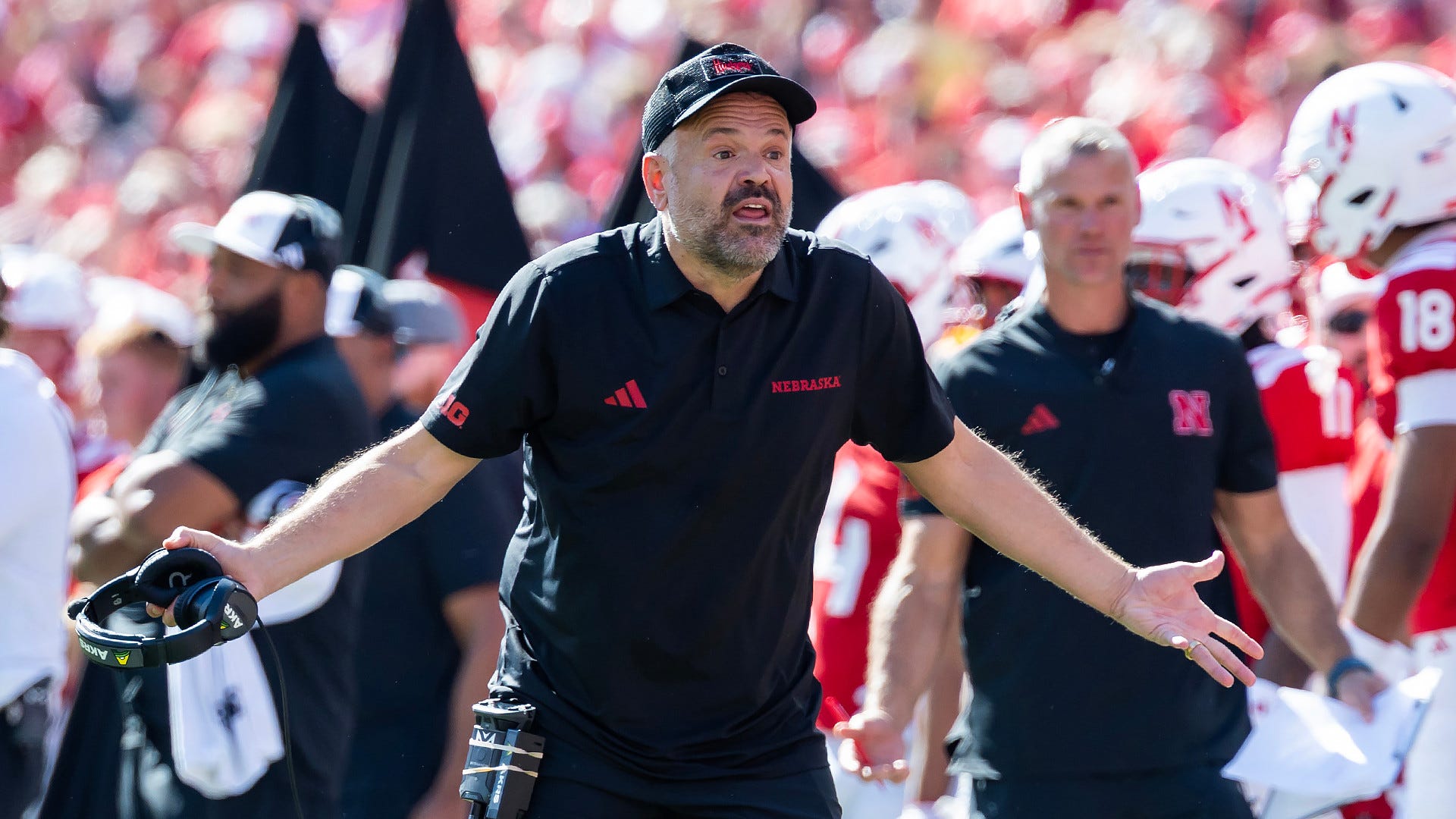
I need proof
Forget the penalty disparity. Forget the missed field goal. The concern that lingers from the loss is bigger than that.
Three times in the first half Indiana faced a tough fourth-down decision, came out on the field intending to go for it, called a timeout and decided against it. It seemed odd for Indiana and Curt Cignetti, a team and coach still on top of the world.
“A lot of them were, ‘God, I just wanted to go for them,’” Cignetti said after the game. “But we weren’t getting anything done and the clock’s running down and let’s just survive it…Those were all on me. At the end of the day, I decided to go conservative in the first half. There was too much time left in the game. We weren’t playing well, they were playing well.”
In the fourth quarter, after Nick Marsh’s 75-yard touchdown changed the game, IU trailed 17-12 before the extra point. Everything here screams “GO FOR TWO.” If Indiana gets it, it only needs a field goal. If it doesn’t, or kicks the extra point, it still needs a touchdown. The Hoosiers sent out the offense to go for two. Nebraska called a timeout. Indiana kicked the extra point instead.
We weren’t playing well, they were playing well.
Why did Cignetti do that? My thought in the moment was he had such extreme confidence—we know he doesn’t lack that—IU could get another touchdown.
“The 2-point play, we showed our formation. I didn’t feel like we had a great second option,” Cignetti said. “After a timeout, we kicked the ball because, still, when you’re down four, you can do that math.”
All these choices ended up working out for Indiana in the end, as did the fourth-and-1 sleight of hand that confused NU’s defense and resulted in the go-ahead score on another long Marsh touchdown.
Rhule said he should’ve called a timeout.
“I definitely thought about it,” linebacker and defensive centerpiece Owen Chambliss said of calling a timeout himself. “I definitely thought about it.”
Now let’s consider Nebraska’s decision not to punt with 4:47 remaining in the game and trailing, 20-17, for the first time. The Huskers are facing a fourth-and-9 from their own 44. Their win probability is 37.7%. If they get exactly the line to gain and the play takes 7 seconds, how long the actual fourth-down play took, Nebraska’s win probability increases to 49.5% (+11.8). If Nebraska throws incomplete, which happens, its probability decreases to 21.7% (-16.0).
Punter Archie Wilson was having his best day as a Husker, averaging 57.3 yards on three punts and downing two inside the 20. He had the wind at his back. If he puts the ball down inside the 20, NU has at least2 a 28.3% win probability. Fail to convert or punt, the challenge doesn’t change for the defense—get a stop as quickly as possible.
The Blackshirts did, forcing a three-and-out, but Indiana’s 33-yard punt gave NU the ball at its own 5 (win prob. 30.8%). Get the same stop and punt on a drive that starts at IU’s 20, and the Huskers have it near midfield with at least a 36% win probability, down only 1.7 points from when Rhule decided not to punt 90 seconds earlier.
Let’s just survive this? The decision to go for it wasn’t that.
The point here isn’t the math or even to second guess with the benefit of hindsight and none of the pressure of making these decisions in real time. The question to ask is which coach’s decision-making better represented the belief that “this is what we do every week?”
Rhule decided he had to win the game with nearly 5 minutes left. Cignetti knew he could play until the final whistle.
As close as the game was, it’s a difficult difference to confront.

B1G Picture
I couldn’t watch UCLA-Oregon live. I checked in shortly before halftime, saw it was 10-6 and thought “that feels familiar.” I checked back in right near the end to see the Bruins win and the dots in this scenario connect themselves if you follow Nebraska. Why does UCLA, under a first-year head coach and on the road against a top 15 team, get to have nice things?
The answer became apparent with a look at the box score. The Ducks’ seven turnovers (and -4 margin) probably swung that 17-15 loss. UCLA’s win had almost nothing in common with Nebraska’s loss based on the games themselves, but to the victor go the spoils. The Bruins-are-the-next-Indiana comparisons were inevitable.
As expected, UCLA rose nine spots in the AP poll to 12th, and barely budged in ESPN’s two predictive ratings, dropping a spot in FPI and rising three in SP+…because it needed seven turnovers to beat a presumptive contender that is now left by the side of the road.
Oregon dropped out of the AP poll but didn’t move in FPI and dropped two spots in SP+…because it needed seven giveaways to lose by two to a team everyone now considers a contender.
For its win in Lincoln, Indiana moved up two spots to fifth in the AP poll, but one spot opened thanks to No. 1 Texas losing to previously 2-2 Oklahoma.3 The Hoosiers didn’t move in FPI after the win but dropped two spots in SP+.
Nebraska? It wasn’t ranked in the AP poll last week, but it didn’t move much in the models either…because it played well. The Huskers moved up a spot to 12th in FPI and down two to 14th in SP+.
None of this is as good as winning the game, snapping the ugly streaks against ranked teams, either. The loss is the loss, the pain is the pain. Can’t be changed.
But this is the edge predictive models have—they only look forward.
Nebraska is off to Oregon, and the two teams aren’t viewed much differently than they were a week ago outside of public perception. Maybe the Huskers will see their former quarterback. Maybe the Ducks are reeling. Maybe they’ll play like their season’s on the line. Hard to know.
Probably better to be Nebraska right now, though.
“There’s a lot of teams that lose a ball game and go on to have a great year,” Rhule said. “Indiana has every right to believe they can have a great year, and so does Nebraska.”
He went on to explain he was just talking about how Nebraska played, not a moral victory. He hoped “everyone can understand that difference.”
It’s a logical approach. Makes perfect sense. It’s just hard at times, and, given the streaks, it might be hardest at Nebraska right now.
More on the Ducks, coming up.
A punt inside the 10 would’ve been good for at least 29.2%. Any punt that crossed the line of scrimmage would’ve produced a better win probability than what Nebraska had after failing to convert. Of course, you give up the increased upside of a conversion. Really, it’s just comes down to what the real-time odds are to convert a fourth-and-9. They’re probably not better than 30%. So 30% of the time NU ends up with a win probability approaching 50% or better and 70% of the time it ends up with one that’s likely 28% or better if it punts. As Cignetti said in a different context, “you can do that math.”
Why does Oklahoma get to have nice things?
I come out of this game disappointed with the loss but highly encouraged by the way this team played. Defense against the run (a big question coming into the season) was exceptional considering it was against Indiana's run game. Offense with Dana and Colandrea made things happen and still left a lot on the table. Not perfect by any means, e.g. the missed field goal and the 2 huge big plays given up by the D, but so much better than we've seen in previous years. Agree with Rhule - not a moral victory, but I see it as a sign that this team is for real.