


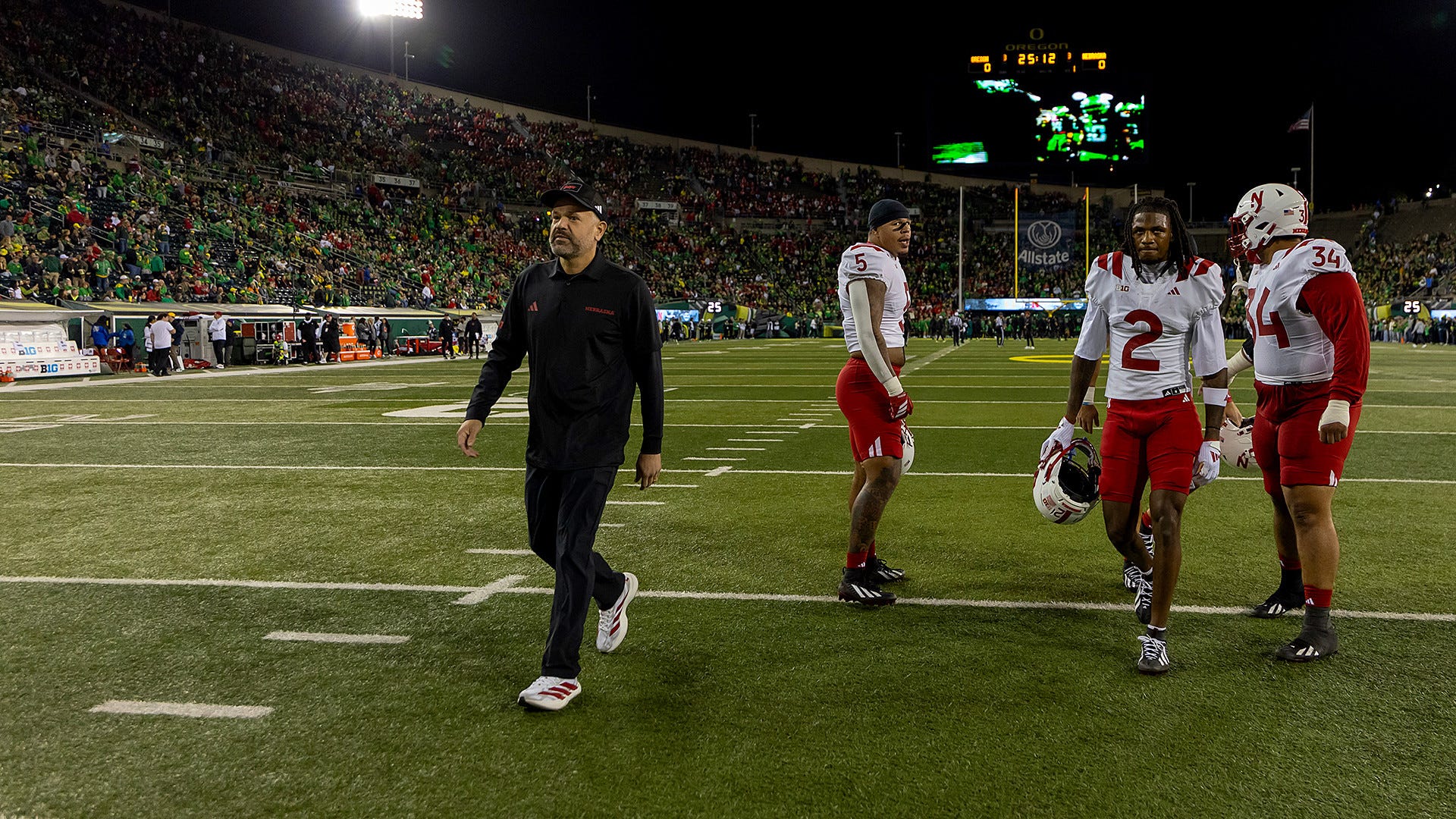
The surest sign of desperation during a crumbling coaching tenure is to fire the coordinators. It has often been the last card in the deck, and if it isn’t the right card, it’s time to get a new deck.
The news Saturday that Matt Rhule had fired offensive coordinator Dana Holgorsen didn’t come as much of a shock, but it signaled two things. To me, they were in this order.
1) No change is coming at the top no matter what happens over the final three games.
2) Nebraska had to do something that said it was addressing this season’s Act II collapse. This was something.
“Like so many of you, I am angry, I am disappointed and I am frustrated with our results this season,” Rhule said in a statement. “As the head coach, I am ultimately responsible for every aspect of our program—including wins and losses—and it is my responsibility to make changes when they are warranted. While there are many areas that need improvement, our offensive plan and execution is simply not working.”
Since scoring 48 points against Maryland Oct. 3 to move to 5-0, the Huskers offense has failed to top 17 points in four consecutive losses.
Last Monday, Rhule called Holgorsen “one of the best offensive minds of our generation.” On Saturday, he was gone. Quarterbacks coach Glenn Thomas will take over play-calling duties. He was Rhule’s OC or co-coordinator for seasons at Temple and Baylor as well as holding those roles at UNLV and Arizona State.
Maybe not much of a case for the change needs to be made, but Holgorsen’s departure deserves some nuance. Rhule’s assessment of Holgorsen’s acumen is shared by plenty. He came to Lincoln and got going under crazy circumstances, taking over in November 2024. He stepped into a previous crisis on offense and eventually made some gains. The Huskers went from 2.08 points per drive in 2024 to 2.85 last season and, against a tougher schedule, 2.71 through 10 games this year.
As a seasoned coach, Holgorsen brought with him the hard-earned respect and some of the fatalism of Sherriff Ed Tom Bell.1 He’d done good in this world before, but the world was changing. Notably, Holgorsen did not have a contract beyond this season.
If there’s a detailed reason for Holgorsen’s firing—beyond the last four2 games—it might be that the rhythm he had as a play-caller at different stops in different leagues never showed up at Nebraska. In the Big Ten. In today’s Big Ten.
The chart below show’s Nebraska’s average points per drive (PPD) for Holgorsen’s 24 regular season3 games at NU. The Huskers’ PPD for all4 drives, drives against G6/FCS opponents and drives against power conference opponents. It includes all averages by quarter as well, which is where the rhythm applies. The average for a Big Ten offense (2024–26) is included for reference.
That might not seem eye-popping at first glance, but a couple of things worth noting. First, the numbers against G6/FCS teams really pull up the overall average despite that being just six games under Holgorsen.5 Against P4 opponents, Nebraska was under the average Big Ten offense overall and by quarter. When the average Big Ten offense crested in the third quarter, Nebraska’s cratered. Over 24 regular season games, Nebraska scored 18 touchdowns on drives starting in the third quarter. It never scored more than one in a game.
Another, perhaps better, way to picture this is by breaking the opposition into two buckets, the good defenses and everything else. Using the respective year-end SP+ defensive rankings for this worked well by accident: Holgorsen’s offenses played 122 drives against top third defenses and 123 against the bottom two thirds. This is how many total points those offenses scored against each group.
Two-thirds of the total points scored under Holgorsen came on half of NU’s drives and they were against the bottom two-thirds of college football per defensive SP+.
Combine those two things, a different offensive rhythm from the average Big Ten team and an inability to produce in the games that really mattered,6 and you have some evidence, and maybe a more detailed explanation, for Rhule’s decision over the weekend.
Holgorsen stepped willingly into the mess that has been Nebraska football willingly, at an inconvenient time. He made the offense better than his predecessor, but not good enough, quickly enough to outrun everything else.
As hard as it is to fire somebody, this next marquee hire might be even more difficult.

If firing and hiring coordinators has often been the last gasp in college football, Rhule is unique—or maybe Nebraska is—in that he’ll get to do it twice7 after his initial hires, which were less than four years ago.
It still looks like, on a second try, he got it right with defensive coordinator Rob Aurich. I would also give Rhule credit for getting it right with Tony White, his initial hire, based on his two seasons in Lincoln. That White recently got fired along with the head coach8 at Florida State only supports a previous Rhule assertion that his defenses have been good everywhere he’s been as a head coach. It’s accurate. Defense is the calling card of a Rhule team, and that is so far true in Lincoln, too.
Hasn’t been enough, which puts a lot of weight on the hire to come. What sort of offense complements what Nebraska has mostly proven it can do on defense? Who is that coordinator? How good is the pool of candidates when it seems clear the expectation for Nebraska next year will be, given an expanded field of 24 teams, playoff or you’re looking for another job next December?
It’s possible, given the context of the money at stake and the continually changing face of college football, that Rhule has found a bonus card in the deck. We don’t know what it is yet, but we know it’s the last one.
“He'd have to say, “OK, I'll be part of this world.”
This included three of the six least efficient scoring games, based on yards per point, of Holgorsen’s NU tenure—Washington, Indiana and Illinois.
I removed bowl games as they are alien encounters. At least the ones non-playoff teams attend.
In all cases, I removed end of half and end of game drives.
That’s what 68-0, 59-7, 56-7, etc. do for you.
Like the last four.
Mike Riley only got (or had foisted upon him) Bob Diaco. Scott Frost only got Mark Whipple.
Another example of an embattled coach making a splashy change as an acknowledgment things ain’t going well. Mike Norvell coaxed White out of Lincoln after going 2-10 in 2024. FSU, by all reports, considered firing Norvell after a 5-7 season in 2025, but waited until the Seminoles started this season 3-5.
It would be awesome if we could pry Jason Beck away from Michigan…
.
.
.
Geez I slay me